NATO’s role as a deterrent is still critically important to the US
June 17, 2021
Joe Biden this week is wrapping up his first trip abroad as President of the United States. Reasonably successful week, brought him to the G7, EU, face-to-face with Vladimir Putin. He also attended a meeting that brought NATO heads of state together for the first time since December 2019. Former President Donald Trump was no fan of NATO, though saying it was obsolete was the one thing he admitted he was wrong about in foreign policy as president, so kind of interesting. But Biden's strong support for the organization was a welcome change for the military alliance.
Not everyone out there is happy about a warm embrace from the US of NATO. Historian Stephen Wertheim just wrote a piece in The New York Times entitled "Sorry, Liberals. But You Really Shouldn't Love NATO." It's a provocative argument and we think it misses the mark in a few important ways. So we're taking out the Red Pen.
Let's start at the beginning. NATO, the North Atlantic Treaty Organization, was founded back in 1949 in the wake of World War II. It was largely a response to the Soviet Union. Its mission was to protect European democracies, both diplomatically and, if necessary, with military force. Many people have challenged the existence and the point of NATO since the Soviet collapse back in '91, not just Wertheim, but we take issue with some of the arguments that are presented here.
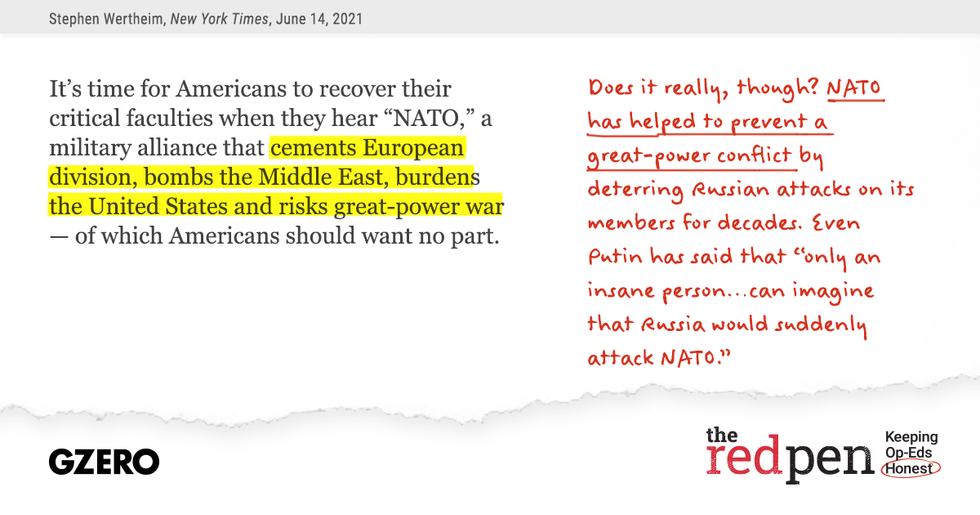
Number one, Wertheim argues that NATO's existence risks great power war, I quote, "that the US should avoid like the plague." Does NATO really bring that risk though? On the contrary, we'd say it's helped to prevent a great power conflict by deterring Russian attacks on its members for decades and still now. Even Putin has said, as president, that only an insane person can imagine that Russia would suddenly attack NATO. That feels like a deterrent effect to me. Keep in mind that Article 5 of NATO, the pledge that an attack on one member nation is an attack on all, has actually only been invoked once, by the United States, after 9/11.
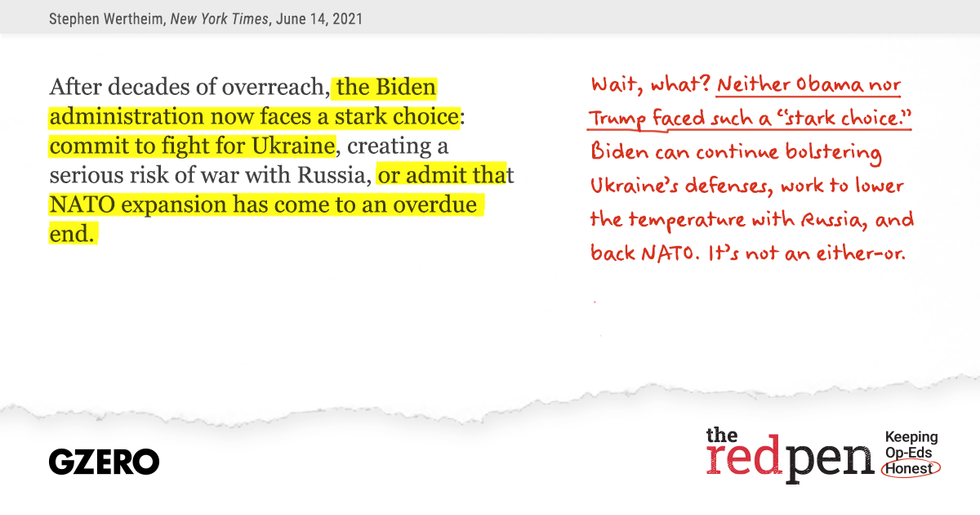
Next, Wertheim contends that "the Biden administration now faces a stark choice, commit to fight for Ukraine, creating a serious risk of war with Russia, or admit that NATO expansion has come to an overdue end." Wait, what? Neither Obama nor Trump actually faced such a "stark choice." Biden can continue bolstering Ukraine's defenses, Obama didn't want to do that, Trump did, work to lower the temperature with Russia and back NATO. This is frustrating to Ukraine's president who wants full membership and during the NATO summit tried tweeting that Ukraine was really, really, really about to become a member, and he got precisely nowhere. It's not actually an either/or.
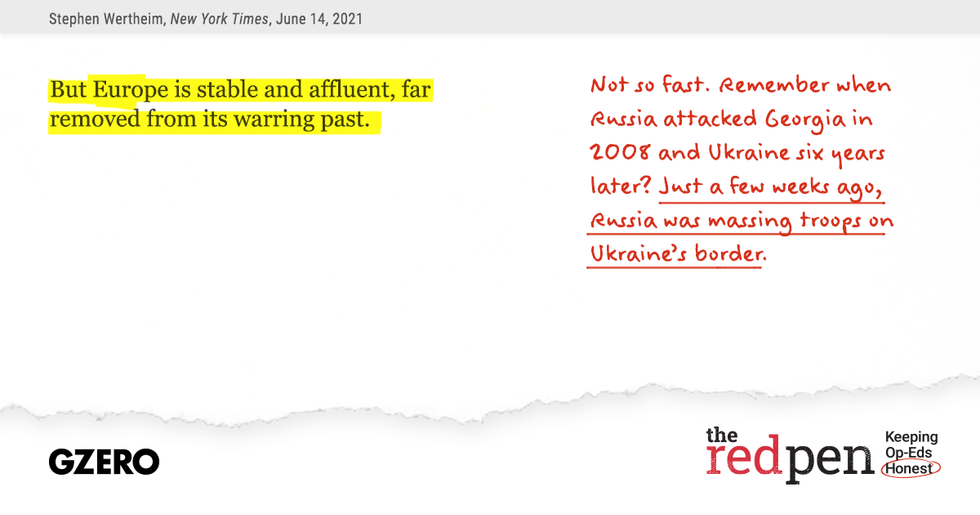
Wertheim also writes that "Europe is stable and affluent far removed from its warring past." Meaning, of course, that it no longer needs a military alliance with the US or US involvement in it for protection. But remember, when Russia attacked Georgia in 2008 and Ukraine six years later, just a few weeks ago, Russia was massing troops on Ukraine's border. No one thinks Russia wants to overrun the continent with tanks as Wertheim suggests. But how about threatening Europeans with cyberattacks, with nerve agents on their individual citizens? These concerns are real, they cannot easily be dispensed with.
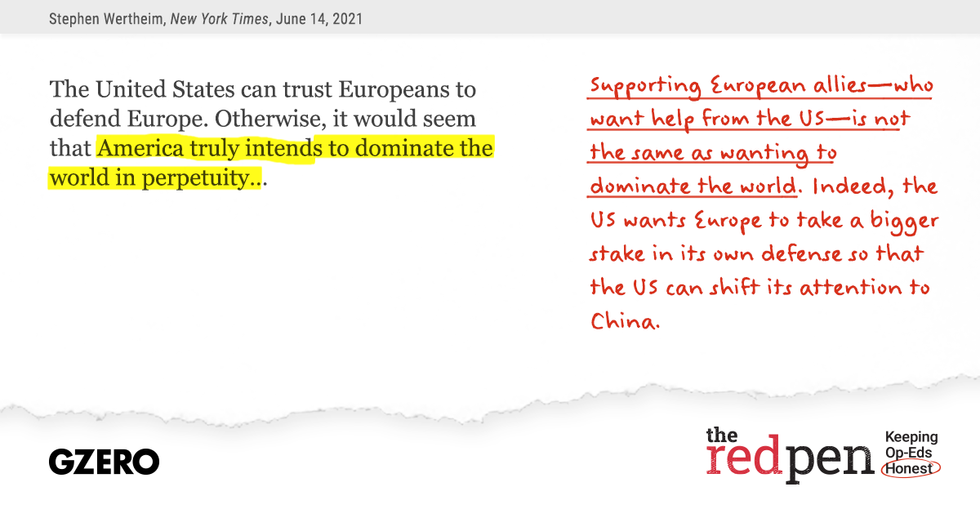
Finally, Wertheim concludes that if the United States doesn't trust the Europeans to defend themselves then it "truly intends to dominate the world in perpetuity." Number one, that's wildly overstated given the role and impact and power of China globally. But to talk just about the North Atlantic frame, supporting European allies who want help from the United States, by the way, as is very clear from the NATO summit itself, is not the same as wanting to dominate the world. Indeed, the United States wants Europe to take a bigger stake in its own defense to allow America to shift more of its attention to China. And Wertheim's argument ignores the fact that Europe still trusts the United States, even if not as much as it has historically and wants the US to contribute to the continent security through NATO. In fact, the Alliance expanded precisely because Eastern and Central European and Baltic countries like Lithuania and Estonia wanted a guarantee against Russian military aggression. NATO has served its purpose on that front.
In a meeting this week with NATO's secretary general, Jens Stoltenberg, President Biden affirmed the US commitment saying of the Alliance, "If there weren't one, we'd have to invent one." Well, there is one, and I grant you NATO needs a bit of reinvention. But should the US back out completely? Sorry, Stephen Wertheim, but not right now.
That's your Red Pen. Hope you found it useful. See you again soon. In the meantime, stay safe and avoid fewer people.