
Skip to content
Search

Latest Stories

Graphic Truth

Graphic Truth: BRICS economies eclipse the G7

BRICS economies eclipse the G7
Luisa Vieira

In 2001, a Goldman Sachs economist coined an acronym for the four largest and most promising “emerging market” economies: Brazil, Russia, India, and China became known as the “BRIC” countries.

Five years later, reality imitated art when the countries decided to begin meeting regularly at “BRIC summits,” with the latest occurring in Kazan, Russia, this week. The subsequent inclusion of South Africa upgraded the “s” to a capital letter: the BRICS.


The group, which lacks formal treaties or binding obligations, has always been united more by what it opposes — US dominance of global financial systems — than by what it supports.

After all, it’s a hodgepodge: energy exporters (Brazil and Russia) and importers (China and India), democracies (India and Brazil) and non-democracies (China and Russia), allies (Russia ❤️China) and adversaries (India x China).

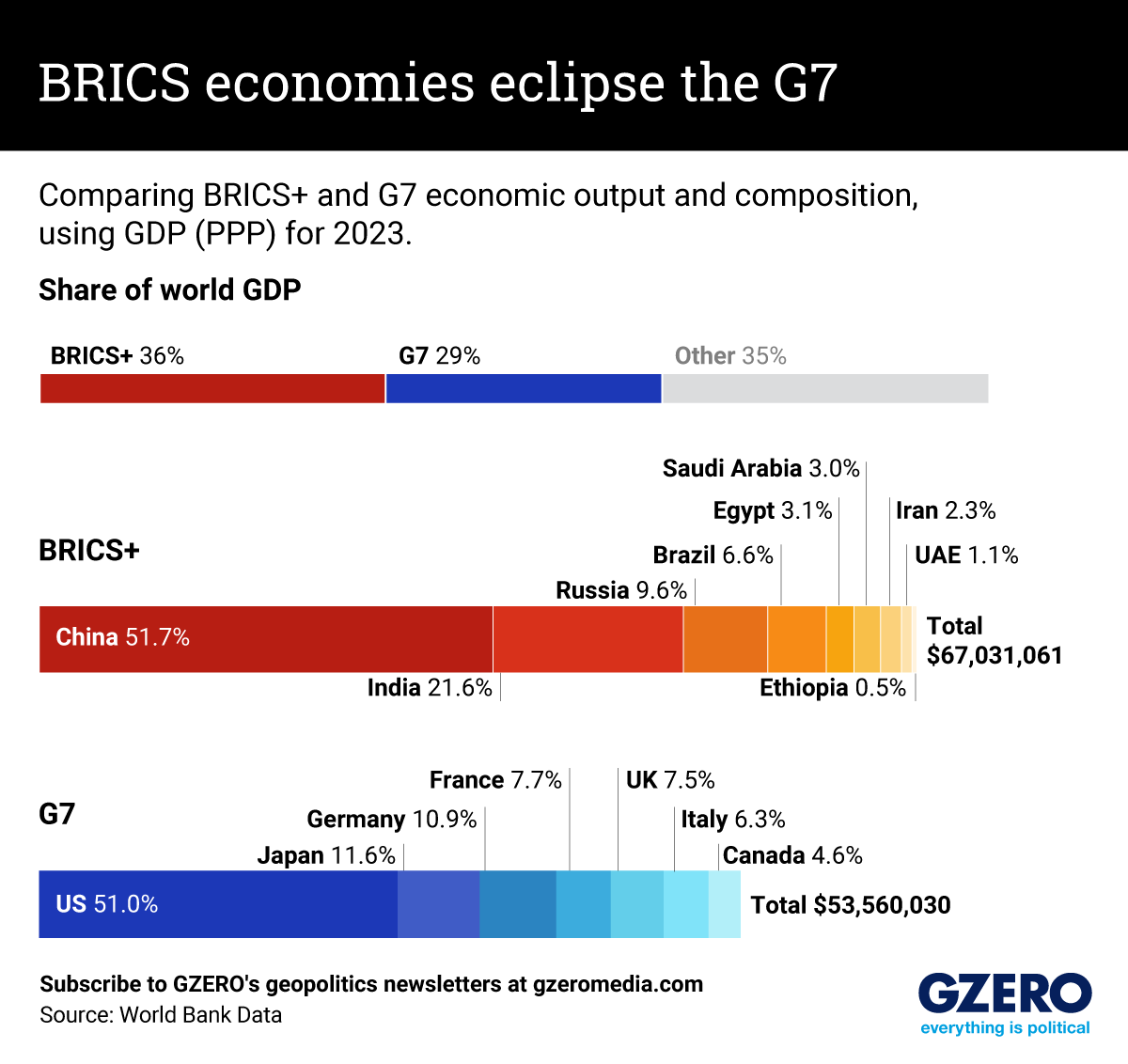
But the economic clout of the group is, on paper, formidable. With the addition of Iran, Egypt, Ethiopia, Saudi Arabia, and the United Arab Emirates this year, the BRICS+ economies account for 36% of global GDP – while the G7 group of wealthy democracies amount to just 29%. But, of course, there’s a catch: China and the US each contribute more than half of their respective group’s GDP.

Here’s a look at the economic size, and breakdown, of the BRICS+ and the G7 group it hopes one day to eclipse — not only economically but also geopolitically.


More For You

​Iran war threatens water access in Middle East

Iran war threatens water access in Middle East

Natalie Johnson, Eileen Zhang
As missiles fly and oil prices soar, the Iran war is exposing another major resource vulnerability in the Middle East: water. Drinking water has been a scarce commodity in a region defined by a dry climate and low rainfall, but attacks on the region’s desalination plants, which convert seawater into potable water, threaten to open a new front.At [...]
​Opinion polling on views on Iran war.

Opinion polling on views on Iran war.

Natalie Johnson
There’s a striking gap in how Americans and Israelis view the US-Israeli war on Iran. Polling done by the Israel Democracy Institute showed the attacks have overwhelming support among Israelis. A separate poll done by NPR/PBS News/Marist revealed a barely a third of Americans back them. That disparity matters strategically for Israeli Prime [...]
Iran conflict: who could run out of weapons first?
The US and Israel have weapons and defense systems that are far more sophisticated than Iran’s. Precision missiles. Advanced radar. Missile defense systems stacked on top of each other. The plan going into Iran was simple: hit hard and fast, destroy Tehran’s military, and force the regime to fold before the fight dragged on. [...]
Oil and gas markets respond to the conflict in the Persian Gulf
The conflict in the Persian Gulf is already disrupting shipping in one of the most significant oil and gas-producing regions in the world. Tanker traffic in the Strait of Hormuz has all but ground to a halt, and major oil and LNG facilities in Qatar, Saudi Arabia, and the United Arab Emirates have been disrupted. Meanwhile, oil and gas prices are [...]