Skip to content
Search

Latest Stories

Analysis

The World Economic Outlook is rosy … on the surface at least

​Secretary of Treasury Janet Yellen speaks about her key priorities for the 2024 Annual Meetings of the IMF and World Bank during a press conference in Washington DC, USA, on October 22, 2024, at the Department of Treasury Headquarters.

Secretary of Treasury Janet Yellen speaks about her key priorities for the 2024 Annual Meetings of the IMF and World Bank during a press conference in Washington DC, USA, on October 22, 2024, at the Department of Treasury Headquarters.

(Photo by Lenin Nolly/NurPhoto)

The International Monetary Fund and World Bank released their much-watched World Economic Outlook on Tuesday, projecting that the world economy will grow by 3.2% in 2025 as inflation cools to an average of 4.3%.

It provides a fairly rosy picture, and these two key institutions in emerging economic development are urging the governments they work with to seize the moment by loosening up interest rates and cutting down on debts and deficits. In other words: Inject more money into economies and use the resulting growth to balance national checkbooks.


That picture is based on some YUGE assumptions, though – first and foremost being policy continuity in the US. “Over coffee and in the halls of the Annual Meetings, everyone is talking about one thing,” says Eurasia Group’s Rob Kahn. “Trump.”

The World Economic Outlook hints at the problem, noting that “upgrades to the forecast for the United States [are] offsetting downgrades to those for other advanced economies” like China and the EU. If Trump carries out the major overhauls to US trade, industrial, and fiscal policy that he is promising, the assumptions that undergird global growth projections collapse, and the picture grows much darker, particularly for key middle-income economies.

“Trump’s policies would be inflationary, which creates headwinds for growth in the developing world,” Kahn explains. Countries like Brazil, Mexico, and South Africa — brimming with potential — could find themselves unable to effectively manage monetary policy and see their economies lose steam.

Representatives from vulnerable economies seem to know the risks they run in saying anything at the moment. In response to a question from GZERO about the risks of a Trump presidency for developing economies, Filipino Secretary of Finance Ralph Recto said Manila felt confident in its alliance with Washington and expected it could avoid the worst consequences through that strong relationship. Argentine Undersecretary for International Economic Affairs Candelaria Alvarez Moroni echoed Recto’s argument about political cover, while Nigerian Finance Minister Wale Edun said his country was a “bystander” to the US election.

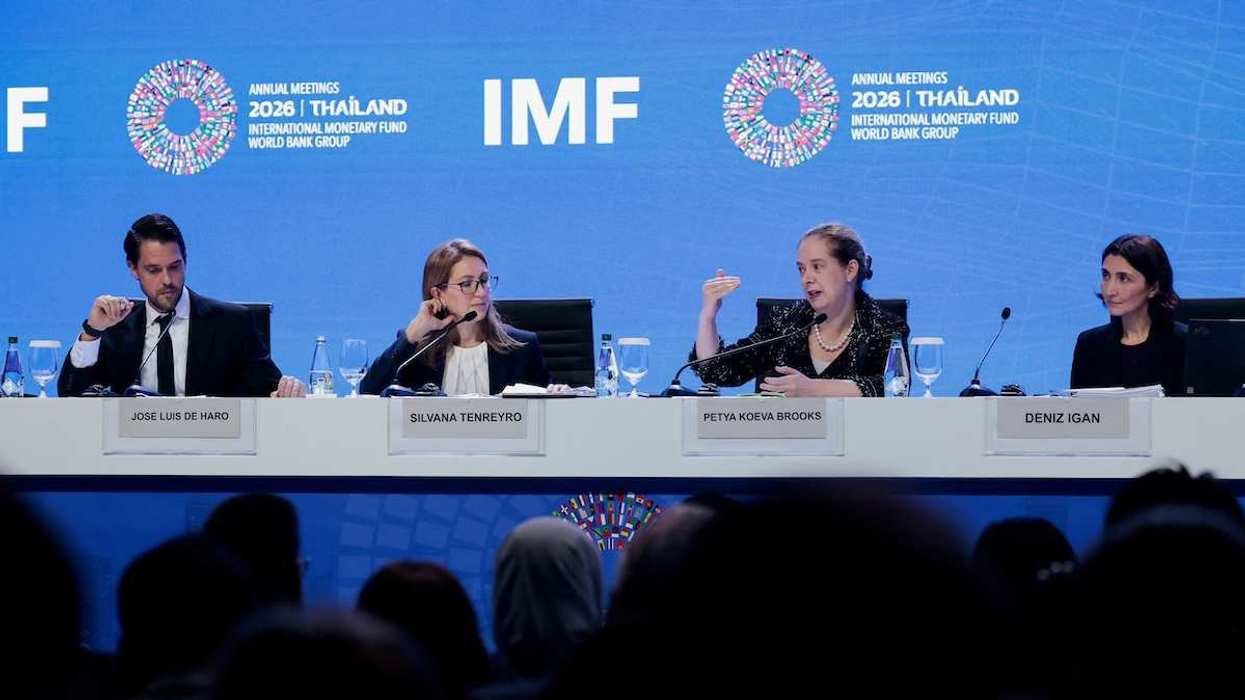
We’ll see how their tunes might change at the Spring Meetings in Bangkok, four months into the new US administration.
More For You

Trump’s farm troubles

U.S. President Donald Trump holds up a "Make Our Farmers Great Again" cap during a roundtable discussion on workforce development at Northeast Iowa Community College.

REUTERS/Joshua Roberts
Is US President Donald Trump going whole hog for the farm vote?Today, Trump is expected to announce two new efforts designed to help the agriculture industry: new guidance on farm equipment and an expansion of government loan guarantees. It’s his second overture to the farm sector in three months. In December, he announced a $12 billion aid [...]
​Smoke rises following an explosion, after Israel and the U.S. launched strikes on Iran, in Tehran, Iran, March 3, 2026.

Smoke rises following an explosion, after Israel and the U.S. launched strikes on Iran, in Tehran, Iran, March 3, 2026.

Majid Asgaripour/WANA (West Asia News Agency) via REUTERS
Syria was the first social media war, where the Syrian government harnessed the power of social media to spread misinformation. Ukraine was the first drone war, taking combat beyond the trenches. Now, the Iran conflict is the first artificial intelligence war, as the world’s strongest military embraces the technology.Admiral Brad Cooper, the head [...]
​A foreign tanker carrying Iraqi fuel oil damaged after catching fire in Iraq's territorial waters, following unidentified attacks that targeted two foreign tankers, according to Iraqi port officials, near Basra, Iraq, March 12, 2026.

A foreign tanker carrying Iraqi fuel oil damaged after catching fire in Iraq's territorial waters, following unidentified attacks that targeted two foreign tankers, according to Iraqi port officials, near Basra, Iraq, March 12, 2026.

REUTERS/Mohammed Aty
Four weeks into a war nobody planned to still be fighting, President Donald Trump issued Iran an ultimatum: reopen the Strait of Hormuz within 48 hours or watch your power grid get obliterated. Iran said no and threatened to retaliate against desalination plants and other civilian infrastructure in Gulf countries. Trump must have found this [...]
​German Chancellor Friedrich Merz, French President Emmanuel Macron and British Prime Minister Keir Starmer sit at the start of the E-3 meeting in Munich, Germany, on February 13, 2026.

German Chancellor Friedrich Merz, French President Emmanuel Macron and British Prime Minister Keir Starmer sit at the start of the E-3 meeting, during the Munich Security Conference (MSC), in Munich, Germany, on February 13, 2026.

Thomas Kienzle/Pool via REUTERS
For the first three weeks of the Iran conflict, Europe made its position clear: this isn’t our war. Many countries on the continent joined the US-led invasion of Iraq in 2003, a move that wrought casualties and sweeping political backlash at home. They want to avoid a repeat – especially when the European public largely opposes this war, too.Then, [...]