With the WEF focused on Rebuilding Trust this year, GZERO wanted to talk with someone who knows a thing or two about restoring faith in institutions. So before she set off for the Swiss Alps, we sat down with nine-term former Congresswoman and President of the Woodrow Wilson International Center for Scholars Jane Harman to get her take on the challenges facing delegates at Davos.
Riley Callanan: What forces are eroding trust in international institutions?
Jane Harman: It's a great theme for this conference because Davos is often viewed as too Eurocentric. The theme is an invitation to the whole world to come together because trust is eroding worldwide.
As for what factors are eroding trust, I think there are a few that are really important.
One major problem is aging international institutions failing to solve current problems. A prime example is the UN Security Council, which was formed a lifetime ago in 1945 right after World War II. Today, the Security Council gives Russia the power to veto resolutions condemning it for its unlawful invasion of Ukraine. That, obviously, is a major roadblock to making progress on the Russia-Ukraine war.
The other major problem is grievance politics, or blaming the government for all of our problems. While he wasn’t the first to use this tactic, former President [Trump] showed that this is, sadly, a very effective attack. And when public trust in institutions is diminished, the efficacy of those institutions is as well.
Callanan: To delve into a major security issue, the situation in the Middle East is acutely dangerous because of the number of players that could misstep, leading to an escalation of the conflict. Is there a path to reestablishing trust and de-escalating the security crisis?
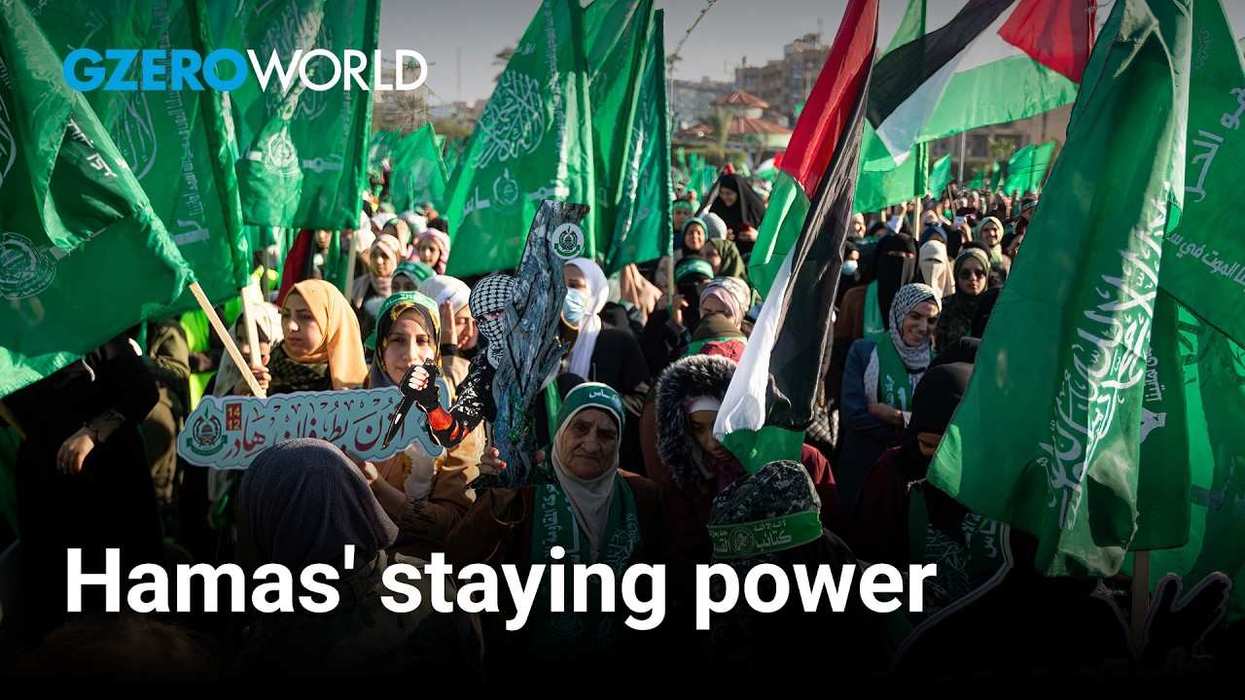
Harman: October 7th was an inflection point in Israel's faith in deterrence.
Ever since Hamas took over Gaza [in 2007], Israel thought it was doing the right things to deter any kind of serious attack from the West. But Israel's faith was misplaced, and it has been replaced with the belief Hamas and groups dedicated to destroying Israel cannot be deterred and have to be defeated.
I support Israel’s goal to destroy the Hamas leadership so that it can't be attacked again. But that doesn't mean that the dream of two states living side by side should be destroyed. The Palestinian Authority, which is not Hamas, recognizes the existence of Israel. I was in Ramallah with President Clinton and Hillary Clinton in the late 90s when their charter was amended to recognize Israel. The hard part is finding the pathway to two states when leadership on both sides isn't eager for it.
The Biden Administration should be commended for working with Saudi Arabia and other Arab states to push for a pathway to a Palestinian state as part of a deal to recognize Israel.
And I think that's a win-win though it doesn't fix every problem in the region. It won't fix the problem of Iran's aggression through proxies. But it would fulfill a dream of the Palestinian people, a dream I hope can be achieved while assuring responsible governance and security in both states.
Callanan: Trust is declining in the US, both in other people and in our institutions. In 2022, only 22% of Americans trusted the government to do the right thing most or all of the time. How does the US lead the way in discussions about international trust at Davos when we lack trust domestically?
Harman: With great difficulty. Our leadership has eroded, and the enemy is us. Political dysfunction is destroying our ability to lead at a time when so many in the world desperately need us to. The good news is that the Biden administration has restored alliances like NATO and built some new coalitions in the Indo-Pacific, like AUKUS and the Quad.
I'm an optimist, or I would have never served nine terms in Congress. But I think this is a very, very steep hill to climb. The problems could not be harder. And without bipartisanship, they'll never be solved.
I think that the Americans who come to Davos, including me, are properly going to get a lot of criticism. Our country is not doing what it needs to do.
Callanan: Throughout your career in Congress and national security, you have had a front-row seat to global cooperation at its finest, and at its worst. Today, the world is confronted with a range of crises that require international cooperation and trust. When it comes to climate change, how do you rebuild trust and cooperation when the players at the table might agree on the outcome, but not on the path to getting there?
Harman: Well, it's easy to make promises; it's hard to keep them. And most of the promises at these climate meetings have not been kept.
They've not been kept for at least two reasons. One is, it takes enormous resources to do the climate transition. The other is that it takes incredible political will.
Then there is another set of problems: Governments can't do this on their own. Technologies and innovation in the private sector are going to figure this out a lot faster than governments will. So cooperation between the private sector and government is crucial. It's just impossible to imagine a real success in combating climate change unless this happens.
Lending institutions will have to provide the money to fund that technology. Banks need to understand that they have to take some risks and lend to the global south, but it would make a big difference if this could be done.
In the end, climate change is truly a global problem. It will not be fixed by a few of the richest countries or the two or three most polluting countries. It has to be fixed on a global basis, and it's a great issue for Davos to talk about.