Germany's close election limits its ability to lead Europe
February 24, 2025
Global Stage LIVE from United Nations WATCH REPLAY
Ian Bremmer, political scientist and president of Eurasia Group and GZERO Media, shares insights on global political events.
Presented by

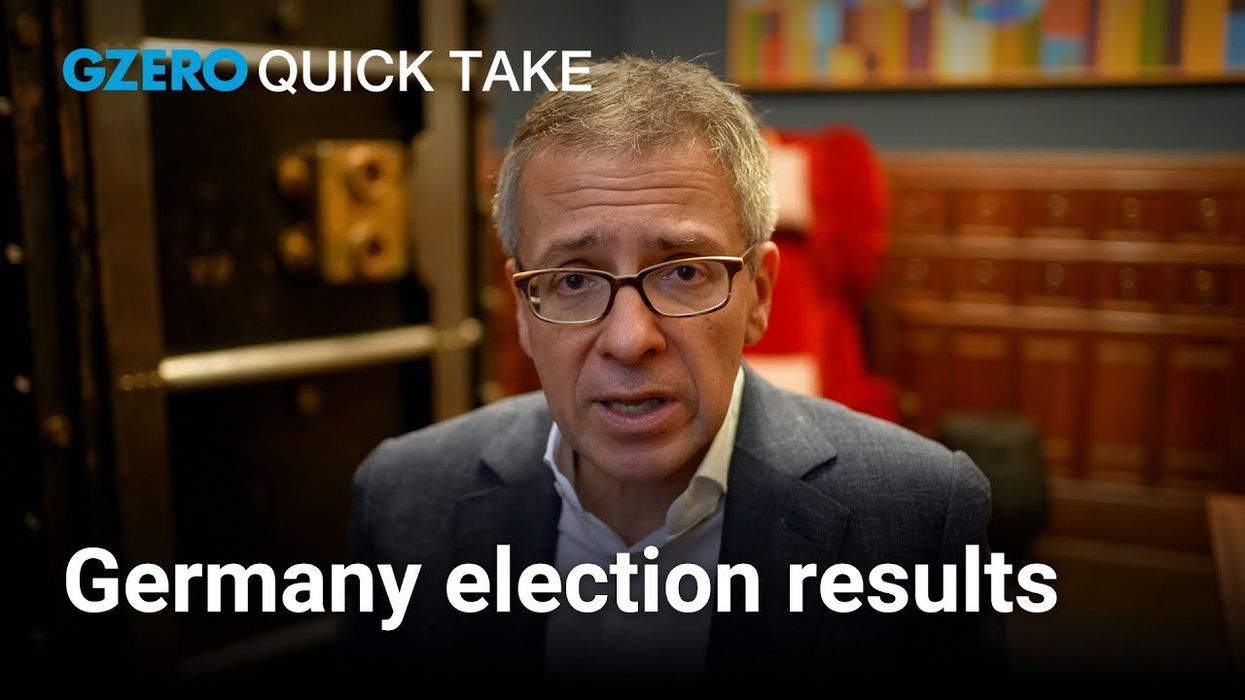
Ian Bremmer's Quick Take: Lots going on the German elections. Probably the most important though, everything around Europe and Russia and Ukraine and the United States kind of dominating the headlines right now. Germany went pretty much the way we all expected. The polls have been very, very steady over the course of the past couple of months. The big question was whether or not you could have a two-party or a three-party coalition that really depended on whether or not parties that were small would get over the 5% hurdle that allows them representation in Germany's parliament, in which case it would be harder to put together a government. You'd need three parties or whether they would stay out. The latter turned out to be the case. Didn't find that out until three A.M. in Germany. Very unusual how close in that regard the election was for those smaller parties, and that means you're going to get a grand coalition, a two-party coalition center-right and center-left.
They don't agree on a lot of policies. It is hard to get good outcomes politically from that kind of a coalition, but it's not unusual in Germany. The other big news, the Alternative für Deutschland performing about as well as they were expected to over the course of the past couple months, they came in a solid second. They won across former East Germany and they got single digits across former West Germany. But that's better than they performed last time around, even though their popularity has been high for a while now, certainly if you think about their trajectory over the some 12 years since they were founded, this is now a party that has a solid shot of being number one in 2029 next German elections, especially if the Germans are unable to turn their economy around. Though on migration, most of the German political spectrum has aligned with where AfD, more or less is just as we've seen across many countries in Europe, like in Italy and in the UK and France and elsewhere.
Okay. So that's the near-term outcome. Still a grand coalition is going to have a hard time spending a huge amount of money on defense or on Ukraine aid or on German growth. And there is some urgency in seeing if you can at least pass more German defense spending outside of their hard fast debt break while the present Scholz-led three-party coalition is in place. Why? Because there is a constitutional majority blocking capacity among the hard left and hard right parties, Die Linke and the AfD in Germany, which means that unless you get one of them on your side, you're not going to be able to do that spending. So the big takeaway here is Germany is probably going to have a really hard time really stepping up as a leader on doing far more in Europe for Europe than even you've seen under Scholz. It's going to be a more powerful government, but not the kind of power that they really need.
So here's a situation where Friedrich Merz, who will be the next German chancellor coming out immediately and saying that they can no longer count on the United States, that even NATO's existence as we look forward to the June NATO summit is open to question that Germany and Europe are going to have to have European defense without the United States, independent of the US claiming that American intervention in Germany's election in favor of the AfD considered by the other German parties to be a neo-Nazi party is as striking and dangerous in intervention and unacceptable as Moscow interventions into Germany's democracy. In other words, the German leadership, the next German chancellor, understanding that the US is an ally, believes that Trump and his administration is an adversary, is an enemy. And that is a truly shocking thing to hear from the incoming German government. Having said all of that, saying it is one thing, taking action to ensure that the Europeans are capable of defending themselves is quite another, and they're nowhere remotely close to that.
Macron in the United States today will be meeting with Trump shortly, meeting with him by himself. Kier Starmer from the UK later this week, same. Are their positions coordinated? More than they have been. But can they do enough? Can they put enough on the table in terms of financing, in terms of boots on the ground in Ukraine absent an American backstop? No, they can't. And I think as a consequence, the baseline expectation is that the US effort at rapprochement with Putin is going ahead. That the US effort of cutting a deal with Putin on Ukraine over the heads of the Ukrainians and the Europeans is largely going ahead. And this of course bodes very badly for the future of Ukraine and Zelensky, but also really does undermine the existence, the strength of NATO as the world's most important collective security agreement. I don't see Trump as wanting to end all military cooperation in Europe.
He just met with the Polish president. It was a very short meeting, supposed to be an hour was 10 minutes. But the important thing for the Poles was announced, which is the US is still committed to maintaining American troops on the ground in Poland. Why? Because Poland is not only very friendly to the US, but it's also moving towards 5% of GDP spend on defense in this year. And it's also said that they're not sending any troops to Ukraine in a post-ceasefire environment. Why not? Well, number one, because they need troops on the ground in Poland. But number two, because the Russians have said that they won't accept any European troops, and right now that's Trump's position. So Poland doesn't want to undermine their important defense protector, the Americans and President Trump. All of this is to say that there's probably going to be more division inside Europe as a consequence of these policies that Trump is putting forward. It's going to be very hard for him to maintain strong unity of Europe, even as they are facing more existential challenges economically in terms of their competitiveness, their growth, and most importantly in terms of their national security. So that's where we are right now. Enormous amount of news coming down the pike this week. Haven't even talked about the latest on Israel and Gaza and China and everything else. But if this is the big news, might as well cover it. Talk to you all real soon.


Keep up with what’s going on around the world - and why it matters.