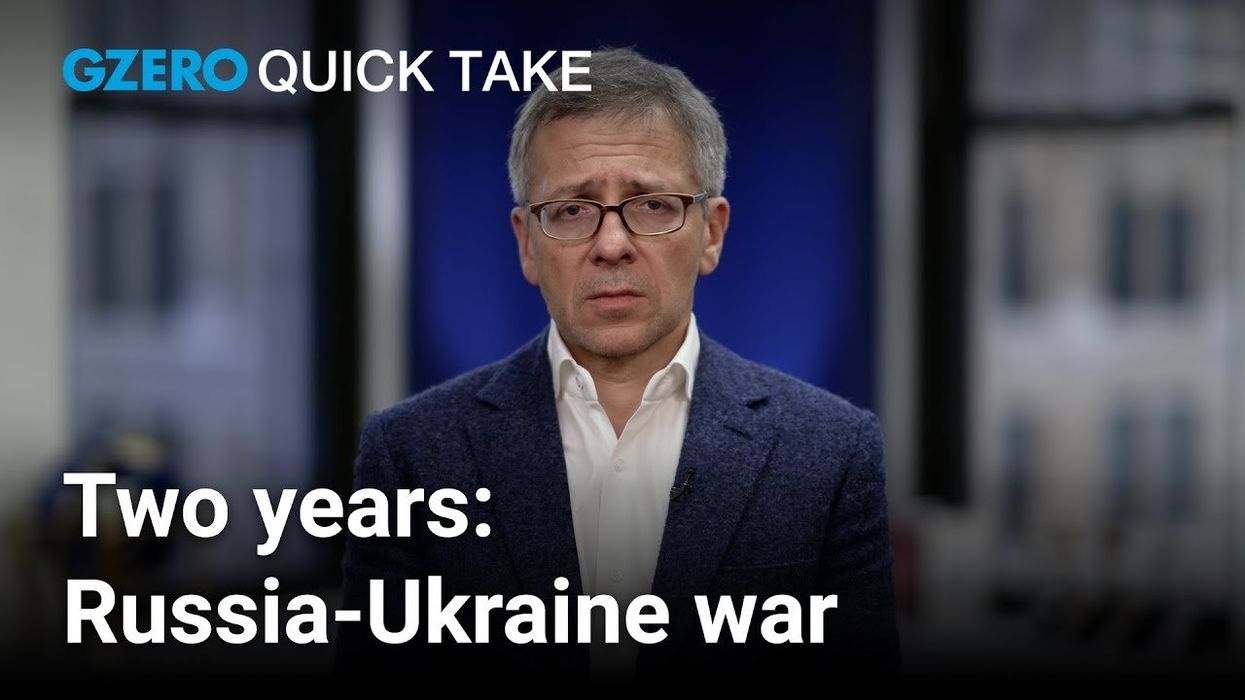
What Ukraine needs after two years of war with Russia
February 23, 2024
Ian Bremmer, political scientist and president of Eurasia Group and GZERO Media, shares insights on global political events.
Presented by

Ian Bremmer's Quick Take: Hi, everybody. Ian Bremmer here and a Quick Take for the second anniversary of the Russian invasion of Ukraine. I don'tknow what you give on a second anniversary, but I know what Ukraine wants. It's ammo, it's more weapons. It is an environment where they have lost their first city, more of a large town to the Russians since last May.
And the reason for that, it's not that Ukrainians aren't willing to fight. It's not a lack of courage. It's not even a lack of troops. It's a lack of support from the United States and Europe. Yes, from the United States and Europe. The United States, which is the largest military power in the world for now, does not have approval from Congress to continue sending military support to Ukraine. Meanwhile, the Europeans are not digging deep. They do have more ammunition to send. But right now that's going to other countries around the world. They have contracts with like the UAE and their willingness to prioritize Ukraine over those contracts because of a national emergency. They'd rather make the money. Look, I understand all of that, but at the end of the day, the Ukrainians are the ones that are taking it on the chin.
And this is a real challenge for the future of the war and the future of NATO. Two years later, NATO is already feeling much more stressed than it was in the immediate aftermath of the war. You'll remember that German Chancellor Olaf Scholz spoke of a Zeitenwende, a turning point where Germany would have to spend more on their national defense and would have to culturally get over their unwillingness to provide weapons for other countries to ensure that Ukraine could defend itself. We saw that from France. We saw it first and foremost from the front line countries like the Baltic states. Tiny but hitting much above their weight. The Poles, of course, not only sending enormous amounts of weapons, but also helping to train Ukrainian soldiers and hosting, even in their homes, millions of Ukrainians refugees that were fleeing from the country, fleeing from the Russian invasion.
Despite all of this, the war has changed its tempo. It's changed its trajectory. Right now. The Ukrainians are on defense. The Russians are taking somewhat slightly more territory, but they're also continuing to engage in missile strikes deep into Ukrainian territory. And we just found out that the first level of advanced weapons, missiles from Iran now being sent to Russia in addition to thousands of railway containers of ammunition and short range missiles from North Korea. This is not an axis of resistance, much closer to an axis of evil. Three chaos actors working together in military alliance to help ensure that there is more instability, more volatility in the world, and that the West is under more pressure. And that is a significant problem for Ukrainian President Volodymyr Zelensky. Two years on the ability of Ukraine to retake all of their territory seems a pipe dream.
It's almost inconceivable that they are not going to be partitioned and no one's going to accept that in the West, certainly not Ukraine, not the United States, at least not under the Biden administration and not any of the frontline NATO countries. And yet the Ukrainians will have no ability to retake that land. What does that mean? Can Ukraine still win?
Well, it depends on what you mean in defining victory. I can see Ukraine having strong security guarantees from the United States, the United Kingdom, Poland, maybe some others that could prevent the Russians from taking more Ukrainian territory, prevent them from being able to overthrow Ukraine. I can imagine large amounts of money, especially from Europe, which has done the lion's share of the economic support from Ukraine even more than the United States has, though not many people talk about that over the last two years to help ensure that Ukraine will be able to reconstruct its economy, its infrastructure, its system.
And I can also see Ukraine being able to join the European Union over the long term, which allows them to have economic and political reforms that will improve the lives of the average Ukrainian. That is a win for Ukraine in the sense that it would afford the vast majority of Ukrainians a much better life and future than they would have had before the Russian invasion in 22 or before the Russian invasion in 2014. But there are no guarantees. And absent significant and committed support ongoing from the Americans and Europeans to ensure that future, the potential that the Ukrainians will be overthrown, they'll lose more of their territory and that the country will fall apart, becomes greater. And that certainly would feel like a Russian victory in Ukraine. It's not a Russian victory globally because of course in that environment Russia would still have the majority of its assets, hundreds of billions of dollars externally frozen. The Russians would have massive sanctions from the West and they wouldn't be able to do business with them going forward. That means particularly stranded gas because they don't have the infrastructure to pipe it anywhere else. It means that Russia is seen as a rogue state whose principal allies are countries like Iran and North Korea, not the friends that you really want to have on the international stage.
That's embarrassing for them. It's also a loss. It's a loss because NATO has expanded Finland and soon Sweden, which is ostensibly why the Russians wanted to invade Ukraine in the beginning because they didn't want more of a NATO's threat against them. And now they have much more that they have to defend against. Who do we blame for all of this?
Of course we blame Putin. But you know what? I also blame NATO. I do think that NATO's is responsible in significant part for the Russian invasion of Ukraine in 2022. You know why? Because when Russia invaded Ukraine in 2014, when they illegally annexed Crimea and when they illegally sent their little green men who we all knew were really Russian soldiers and occupied illegally, parts of southeast Ukraine, the West did virtually nothing. NATO did virtually nothing. The view was, “hey, these guys aren't a part of NATO. We're not responsible.” In fact, not only were sanctions very limited, but the Europeans sent heads of state to go and congratulate Putin for the World Cup that he was hosting at the very moment that the Russians were occupying illegally parts of Ukraine. This war has been going on for ten years and NATO has been unconcerned until the Russians finally decided in 2022, “Hey, we can get away with this. The Americans, the Europeans don't really care. Look at what just happened in Afghanistan. We're going to invade the entire country. We're going to get rid of Zelensky once and for all. “ A massive misjudgment on Putin's part. But the misjudgment wasn't about NATO's response. The misjudgment was about Russia's own capabilities. And if they had been strong enough to be able to overthrow Zelensky in the two weeks that Putin thought would happen and that the Americans and Europeans did as well, we'd be in a radically different position today. No, it is only the fact that Putin is an incapable leader who is massively corrupt and doesn't get good information from his own people. And it's only because the Ukrainians fought with incredible, almost inhuman courage over the first months and now over two years that Ukraine still has a shot today. It's only because of that that NATO isn't completely at fault for Ukraine falling apart.
But unfortunately, Ukraine's future still very much hangs in the balance and that's going to require a lot more political strength and unity from the United States, from Europe, the transatlantic relationship and NATO, then we may be able to expect going forward. That's where we are two years in.
That's it for me. And I'll talk to you all real soon.

Keep up with what’s going on around the world - and why it matters.