Site Navigation
Latest Stories
Sign up for GZERO Daily.
Quick Take
Ian Bremmer, political scientist and president of Eurasia Group and GZERO Media, shares insights on global political events.
Presented by

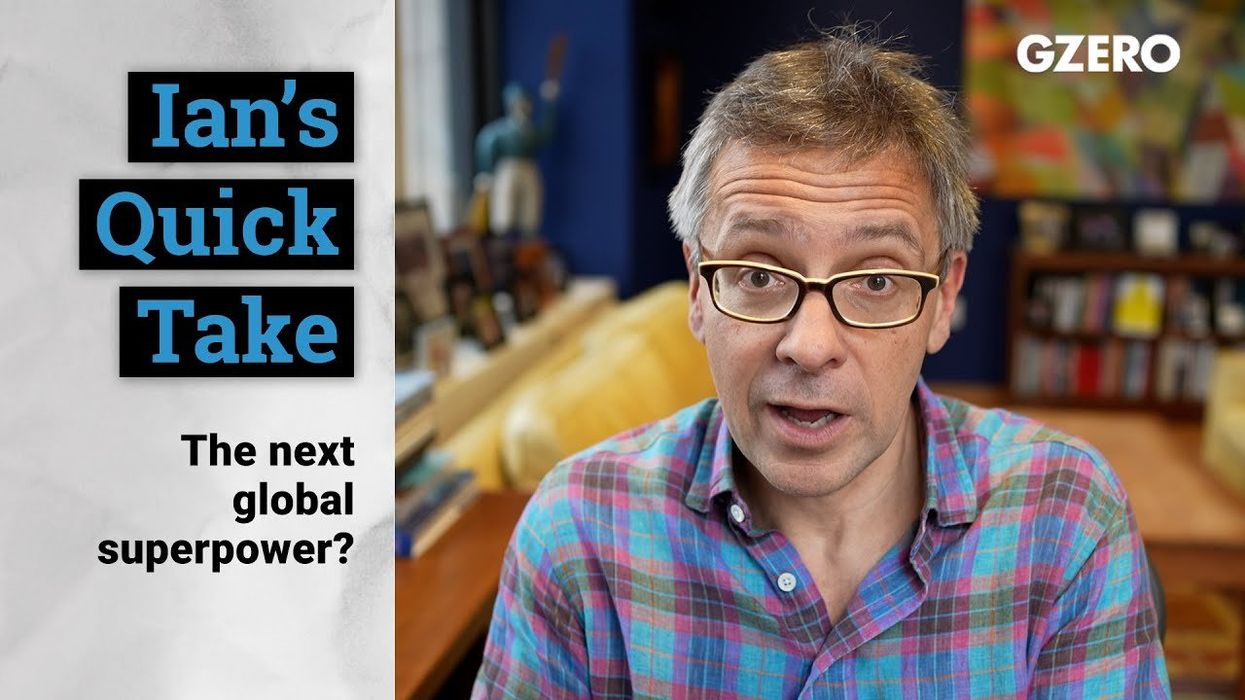
Ian Bremmer's Quick Take: Hi everybody. Ian Bremmer here. A Quick Take for you and my Ted Talk has just landed. So yes, that is what I want to talk about. Kind of, what happens after the GZERO? Who is the next global superpower? Do the Americans come back? Is it the Chinese century? No, it's none of the above. We don't have superpowers anymore. And that's what the talk is all about.
I think that the geopolitical landscape today unnerves people because there's so much conflict, there's so much instability. People see that the trajectory of US-China relations, of war in Europe, of the state of democracy and globalization, all is heading in ways that seem both negative and unsustainable. And part of the reason for that is because it is not geopolitics as usual. It's not the Soviets or the Americans or the Chinese that are driving outcomes in the geopolitical space. Rather it is breaking up into different global orders depending on the type of power we're talking about.
There's a security order of course, and people that think that international institutions and governance doesn't work anymore, aren't focusing on hard security cause NATO is expanding, and getting stronger, and involving not just the Nordics, but also the Japanese, and the South Koreans, and the Australians. The Americans are building out the Quad and they're building out AUKUS, in part because of growing consensus on Russia among the advanced industrial democracies, growing concerns about China. But then also you have at the same time that the US-led national security institutions are getting stronger, the global economic architecture is fragmenting and it's becoming more competitive. And the Europeans are driving some rules, and the Chinese are driving others, and the Americans are driving others. No one's really happy about that, and it's becoming less efficient, and that's because it's a multilateral economic order at the same time as it's a unilateral unipolar security order.
And those are two things that we kind of feel right now, and it's not super comfortable. It's not super stable. The pieces move and they rub up against each other. The Americans trying to have more dominance in certain areas of the economy. When you can make it about national security, like if you talk about critical minerals and transition energy economies or semiconductors, for example, you see all that investment moving away from Taiwan and towards the US, the Netherlands, Japan, other countries. And you can see other areas where the Chinese have more influence in commercial ties and are getting more diplomacy oriented towards them in the Global South, for example, in the BRICS, and now France saying they want to go to BRICS meeting and that's not about national security, that's about economic integration. So these things, they're like tectonic plates and they don't align comfortably. And when they don't and when they move, sometimes you get an earthquake, sometimes you get a tsunami.
But then you have a global digital order. And the digital order, at least today, has no global institutions, has no real domestic regulatory structure and it's dominated by a small number of individuals that run tech companies. It's Meta, and it's Google, and it's Microsoft, and it's Elon and Twitter, and you know, it's individuals and tech companies. And these companies right now are devoting almost all of their time, almost all of their money, almost all of their labor towards getting there first, wherever there is, making sure that they're not going to be made bankrupt or undermined or creatively destructed, if you will, by their competitors, whether that's in China or whether that's, you know, sort of just a few miles down the road in the Valley or someplace else. And because that's the entire focus, or virtually the entire focus, and because the governments are behind and there's no international architecture, it means that at least for the next few years, the digital order is gonna be dominated by technology companies, and the geopolitics of the digital order will be dominated by the decision making of a very small number of individuals. And understanding that I think is the most important and most uncertain outcome geopolitically.
I'll tell you that if I could wave a magic wand, the one thing that I would want to have happen is I want these AI algorithms to not be distributed to young people, to children. If there's one thing I could do right now across the world, just snap my fingers, wave a wand and that regulation would be in place. Because, you know, when I was a kid, and we were all kids, right, except for the kids that are watching this, it was, you know, how you grew up was about nature and nurture. That's who you were. Emotionally, it's who you were intellectually, it's how you thought about the world. It's how your parents raised you, how your family raised you, your community raised you, and also your genetics. But increasingly today it's about algorithms. It's about how you interact with people through your digital interface that's becoming increasingly immersive. And the fact that that is being driven by algorithms that are being tested on people real time. I mean, you don't test vaccines on people real time even in a pandemic until you've actually gotten approvals and done proper testing. You don't test GMO food on people until you've done testing. And yet you test algorithms on people and children real time. And the testing that you're doing is AB testing to see which is more addictive, you know, which actually you can more effectively productize, how you can make more money, how you can get more attention, more eyeballs, more data from people. And I think particularly with young people whose, you know, minds are going to be so affected by the way they are steered, by the way they are raised, and by the way they are raised by these algorithms, we've gotta stop that.
I think the Chinese actually understand that better than the West does. And you know, it's interesting, you go to Washington, you say, "What do you think we can learn from the Chinese?" Not a question that they get asked very often. It's a useful one since they're the second largest economy and they're growing really fast. I would say when they decided that they were going to put caps on video games for kids, that was one that I remember, everyone I knew who was a parent of a teenager said, "I wouldn't mind that happening in the United States." Something like that on new algorithms, social media and AI for young people, I would get completely behind. And I hope that's something we can do.
But there are a lot of issues here, huge opportunities that come from AI, massive amount of productivity gains in healthcare, in longevity, in agriculture, in new energy development, in every aspect of science, and we'll get there because there's huge amounts of money, and sweat equity, and talent that is oriented towards doing nothing but that. But the disruptive negative implications of testing those things on 8 billion people on the planet, or anyone I should say, who's, you know, connected to a smartphone or to a computer, so more than 50% of the planet, that is not something we're taking care of and we're gonna pay the cost of that.
So anyway, you have just heard some of my TED Talk and what I think the implications are, I hope you'll check out the whole thing and I look forward to talking to you all real soon.
More from Quick Take
GZERO Series
GZERO World with Ian Bremmer

Puppet Regime
Quick Take
ask ian
Ian Explains
GZERO Reports
GZERO Europe

The Debrief

GZERO Daily: our free newsletter about global politics
Keep up with what’s going on around the world - and why it matters.