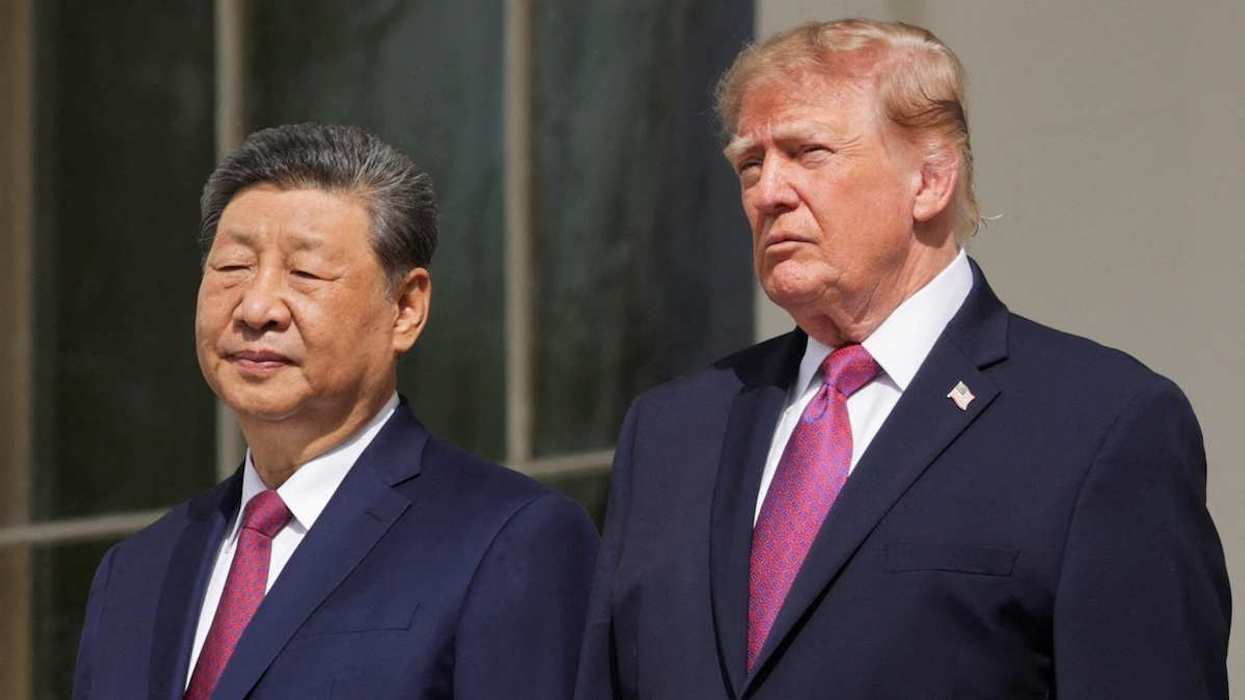
Top diplomats from the US and China will sit down on Thursday for their first face-to-face since Joe Biden took office as US president. Amid deepening tensions over trade, human rights, and technology, the encounter is certain to be a frosty one — and not only because it's in Alaska. Each side will size up the other, make clear its positions, and leave, perhaps without even so much as a closing joint statement.
You'll probably hear and see lots in the next few days about whether the US and China are slipping into a new "Cold War." Well, are they?
The growing rivalry does have a certain 20th-century vibe to it. It's a competition between two nuclear-armed powers with incompatible political systems, playing out across the globe in commerce, technology, and strategic influence.
But this is also very different. For one thing, interdependence is much, much greater. The United States and the Soviet Union had almost no economic ties to speak of. By contrast, the US and China exchange more than half a trillion dollars in goods and services annually, making for one of the top three bilateral trade relationships. China, moreover, owns as much as a trillion dollars in US sovereign debt, and is the largest market for many US firms.
If either economy trips — or is pushed — the repercussions are not only bilateral but global. These are the two largest economies in the world, accounting for 30 percent of global GDP. If US-Soviet mutually assured destruction was a matter of nuclear weapons, the US-China version is that plus the risk of global economic catastrophe.
What's more, this isn't the same zero-sum ideological competition. China and the US have very different political systems. The US is an imperfect liberal democracy, while China is a repressive one party state conducting a massive experiment in techno-authoritarianism. (That's not Daft Punk doing show in a gulag, it's using AI and data not only to keep the trains running, but to shape the behavior of the population.)
Each country is trying to set an example to others — and at the moment democracy is having a tough moment, as journalist Anne Applebaum recently told us. But unlike in the Cold War, neither side is actively — much less violently — exporting a specific kind of governance model that forces third countries to choose sides in ways that imply hard choices about the economic or political system. China, for example, does lots of business with countries that are democratic US allies, and accepting trade and investment from China hardly means renouncing US ties.
The one place where the "Cold War" tag maybe does work? Technology. The United States and China are steadily "decoupling" in the technology sphere — shutting each other out of their technology industries, cutting supply chains, and adopting very different standards for privacy.
And things here really are becoming more zero-sum. Beijing and Washington are pressuring third countries to choose whether to use, say, Chinese-made equipment for their 5G networks or not. There is a danger of the internet and the global tech industry eventually splitting into two rival and incompatible spheres altogether.
And one where it's definitely not helpful. Climate change. There's no serious effort to reduce emissions unless Beijing and Washington, the top two largest polluters in the world sign on. During the Cold War, the US and the USSR's main task was to avoid a conflict that would incinerate the planet. The US and China now have to cooperate broadly to avoid a different, slower burning of the Earth.
And that's the trick for both sides in Alaska and beyond. To figure how to manage potentially unresolvable disagreements on issues like governance, human rights, technology, and trade without rupturing cooperation on broader issues that affect not only China and the US, but the whole planet.