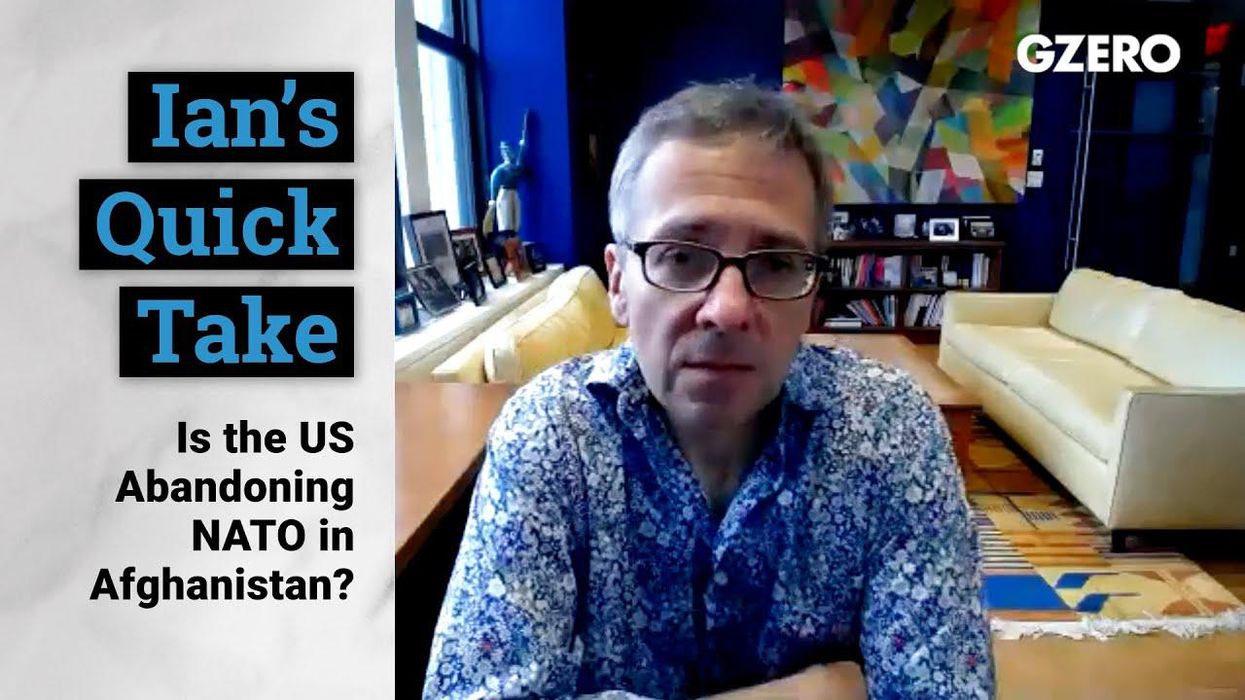
Is the US abandoning NATO in Afghanistan?
May 03, 2021
Ian Bremmer, political scientist and president of Eurasia Group and GZERO Media, shares insights on global political events.
Presented by

Ian Bremmer's Quick Take:
Hi, everybody. Ian Bremmer here. Welcome to your week. Got a Quick Take for you. Wanted to talk a little bit about Afghanistan. The United States has announced, and not for the first time, that we will be leaving, ending the 20-year war. Detractors calling it The Forever War, and with good reason: it is the longest war that the United States has in its history ever fought, spending over a trillion dollars conservatively. Estimated well over 2000 American servicemen and women dead, over 40,000 Afghan civilians dead, and well over 70% of Americans want out, want to end the war. So you can understand why President Biden wanted to make that decision. You understand why former President Trump wanted to make that decision.
There was a thoughtful interagency process in the United States, and I will say that given gains made by the Taliban on the ground in Afghanistan, presently at the peak in terms of territorial expansion over the past years, there was a feeling among those advising Biden, that there was not a lot of confidence that the present levels of military engagement on the ground was sufficient to prevent the Taliban from taking over and the Afghan government from collapsing over the course of a Biden administration. So in other words, the decision being put to him really wasn't about: do you want to stay or do you want to leave? It was more, do you want to leave or are you prepared to expand, to have another surge of American and other troops to help ensure that the Taliban doesn't actually take over the country? And the answer, in relatively short order, was no.
I want to be clear, I'm personally glad that we're able to leave. This has been enormously painful and expensive and dangerous process. It feels unending. We killed bin Laden. We degraded Al Qaeda. Those were the proximate goals for the war, but the idea of building up the Afghan government and leaving stability was always a much taller order than the United States appeared to have stomach for and would have been an immense challenge, irrespective of how much resource the Americans put on the ground.
But I am worried that we're leaving our allies in the lurch and I want to dig into that a little bit. I mentioned that there was a thoughtful interagency process inside the United States of whether the Americans would stay or go, but that was not a discussion had with American coalition partners in NATO who have been shouldering the majority of the burden in the war in Afghanistan heretofore. The coalition together has more troops on the ground than the United States. They've lost, they've suffered more casualties than the United States. And perhaps most importantly, many of them have much bigger domestic concerns about radical Islamic terrorism - think about France, for example, think about Germany, think about the U.K - than the United States, where today terrorism is mostly domestic, homegrown, and it's mostly white nationalist.
We told them we were leaving and they better get on board, and of course, publicly they are, because if the world superpower and their ally is out, then, well, what choice do they really have? But they're really not happy about that and I've had that conversation with a number of allies at this point who are basically saying, "Look, there's no way for us to maintain our presence if the Americans aren't there. There's no way for us to continue economic support given how corrupt the local government is, because if the Americans aren't there on the ground overseeing that process. There's no way to make sure the money's going to where it needs to go. It's going to be wasted." So the view is that this goes from a relatively robust process to one that really falls apart in short order, and the likelihood the Taliban takes over in the coming months to years goes up.
Now, again, I'm not saying that I think that should make this Forever War continue for 10, 20, 30 years. But I do believe that the United States owes it to America's allies to engage in that discussion collectively before we make a decision. I get the point that the Quad is the shiny new object. The United States is much more concerned about China than it is about what's happening on the ground in Afghanistan. The Japanese are seen in many ways as the most critical ally in that regard. First head of state visit to the United States was indeed Prime Minister Suga. They have been underprioritized for a long time, I would argue, appropriately so. Third largest economy, largest economy in the world, allied with the United States and really need the Americans. I get it.
But America's most durable alliance, as much as it is outdated in geographic orientation, still is very strong, we're very trusted partners and that's NATO. And most trusted partners of America around the world remain a part of NATO and are contributing more to NATO over time. We should stay committed, we should stay seen to be committed. First, that means the decision making process on something that is in the interest of the United States to leave, maybe we need to compromise more because of the interests of our allies. We certainly want to work with them more closely. And also, since they're going to be bearing the brunt if the Taliban takes over, they're going to bear the brunt if radical Islamic terror becomes more of a threat to their homelands, then the United States in advance of that, needs to be working collectively with them to help ensure that our fight on counter-terrorism with them is prioritizing their needs to a greater degree.
I think that we have to be willing to admit that Biden as a president, his administration is much friendlier to the allies on balance, is liked, is preferred by most, almost all of the allies on balance. But privately, a lot of the allies are saying that American unilateralism remains, in substance, if not in form on a bunch of key issues, and this was one that I think we booted a bit.
So it's difficult, right? This is not necessarily a quick post tweet to talk about all of these issues because there's a lot going on. I can understand why everyone around this has been deeply conflicted. There are no good answers, certainly. But I think we might've been able to do this one a little bit better. Anyway, that's a bit for me. Everybody be safe. Avoid fewer people, at least if you're in the U.S., and increasingly Europe, they're getting up to speed on vaccine rollout too very quickly, and I'm glad to see it and hopefully the rest of the world soon, soon, soon. Talk to y'all. Be good.




Keep up with what’s going on around the world - and why it matters.