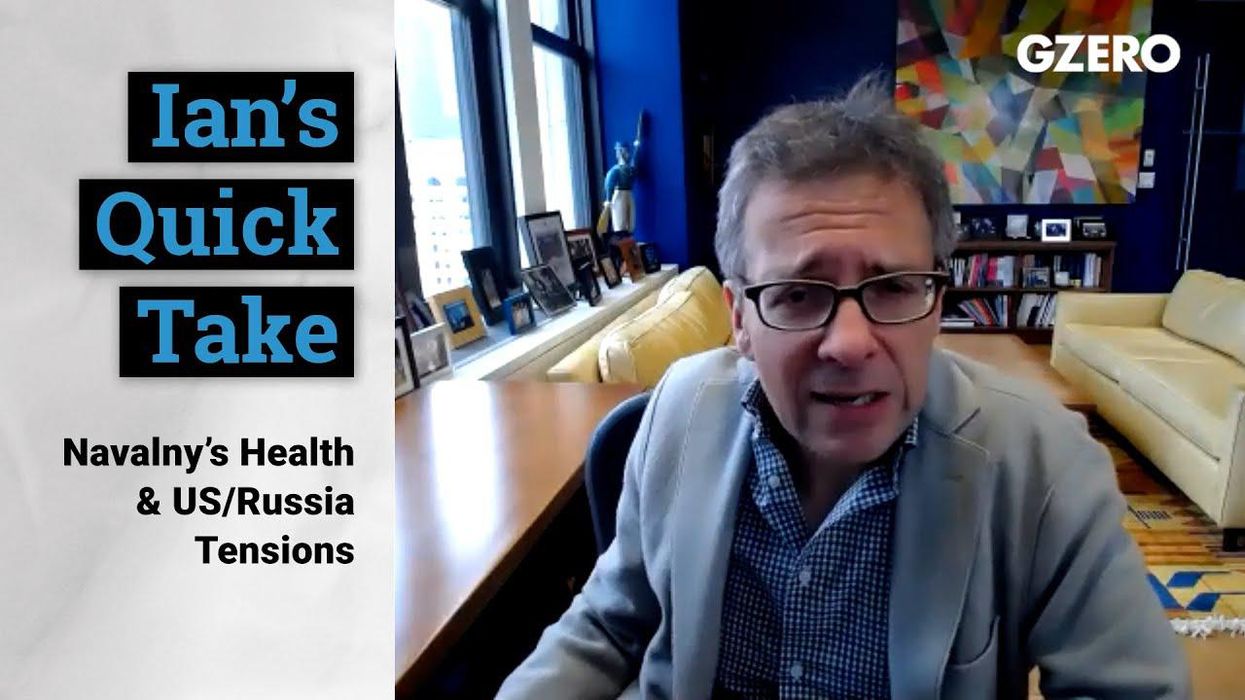
Navalny's health and US-Russia tensions
April 19, 2021
Ian Bremmer, political scientist and president of Eurasia Group and GZERO Media, shares insights on global political events.
Presented by

Ian Bremmer's Quick Take:
Hi, everybody, Ian Bremmer here, kicking off your beautiful spring week from New York City. A little Quick Take. I thought I'd talk today about Russia, going to be in the news this week. Putin doesn't like it when they're out of the news for too long, certainly plenty going on between the US and Russia right now.
I'd say, first of all, to start off, the relationship is in the toilet. We know this. It is the worst it's been since the early '80s. That was true even under Trump. Trump and Putin personally had a pretty good relationship, but Trump wasn't able to get anything really done for the Russians, because both the Republicans in Congress, key members of cabinet under Trump, massive amount of constraints on what Trump could actually do, whether it's trying to bring Russia back into the G7 or recognize Crimea as a part of Russia, or remove or reduce sanctions. None of that actually got done. In fact, the relationship deteriorated over the four years.
But now we've got Biden and the focus is of course, more on human rights. The focus is more on climate change, which means that Russia as a massive energy exporter and particularly in terms of their influence on Eastern Europe and Western Europe on the downstream for gas delivery, for example, something that Biden is much more focused on. So a lot more pressure on the Russians, and the Russians don't care. Their willingness to hit back and show that the Americans are not willing to take any significant risks to constrain the Russians is also fairly significant. And this is playing out in a number of ways.
And perhaps most importantly, for the media this week, will be Alexei Navalny. He has been in jail. He's still very much incarcerated, but has just in the last few hours, been moved to a hospital. Some doctors who have not been able to see him directly say that his health is in danger, that he could potentially die. I have no way of knowing whether that's true or not, but we do know the Russians tried, indeed did poison him before and could have killed him but did not because of some quick thinking medical response. And that, that means that their willingness to assassinate him certainly is there.
Now the consequences, they say ... Jake Sullivan, the national security advisor of Biden says that there will be consequences if Navalny dies in Russian custody. I think the consequences there would be, would be additional sanctions. But they probably wouldn't be all that great, certainly not more than the Russians would expect or be willing to tolerate. What's more interesting perhaps is that over the course of the next couple of days, Navalny's supporters are organizing nationwide demonstrations. They were planning on holding off until the summer, but they pushed it up, because of the health decline. And the date of this, on Wednesday, coincides with the date of Putin's annual State of the Union speech, which goes on for hours. And he takes all of these questions from the media, and he shows what a wonderful guy he is, and how he can talk about just about anything, because he, of course, is the absolute authority in Russia, and nothing he says can or will be used against him. He's not going to like a backdrop of big demonstrations, which means the potential for large scale arrests and violent repression is pretty high. That is going to indeed continue to worsen the relationship between the two countries as well as Russia and the Europeans. But I still don't think this is going to move the needle very much.
A couple of points here, one, all of the sanctions that the US have put against the Russians so far have paled in terms of response to Navalny, compared to what the US did to the Saudis following the Khashoggi assassination. There, you had 76 members of the Saudi government that reported directly into Mohammed bin Salman that were personally sanctioned. The US has done none of that to people that are close to Putin. In fact, they've assiduously avoided putting sanctions on any oligarchs that would embarrass or cause problems for Putin directly. And that's the message, right? I mean, the Russians know that the Americans are capable of doing that, and they also know that it would have major knock-on economic effects. So, Biden doesn't want to do that.
Also, I want to say that as much as it disturbs me, it even repulses me that Navalny is being treated, has been treated the way he is, there is no effective opposition in Russia. It is an authoritarian state. It is like China, and many other authoritarian governments in that regard. And there are many things the Russians have done that are far more brutal and consequential for human rights around the world, like the war, the intervention, the invasion in Georgia, like the cyberattacks against Ukraine, like the invasion into Ukraine, the annexation of Crimea, and much more impactfully and importantly, the little green men into Southeast Europe, where they continue to occupy territory, and where there has been a massive military buildup on the border just over the last couple of weeks. These are bigger deals.
The media and the Americans focus more on Navalny. He speaks English. He is sort of charismatic. He's tall. He's attractive. And I mean, he gives lots of interviews. And so, the Westerners like that. But these other stories affecting poor people that don't get the media time actually matter a lot more. And even there, the willingness of the US to engage seriously, the US was planning on sending ships to the Black Sea. They demurred. They decided against doing that because the Russians told the Americans that this was just two weeks of military exercises, and then they were going to stop. But they still occupy Ukraine. It's a sovereign nation. And the Americans indeed had said before, along with other countries, that if they got rid of the nuclear weapons that the sovereignty would be respected. That was a treaty. So much for that.
So, I mean, I think those are more significant things. Just like in Saudi Arabia, the war in Yemen has been much more consequential than Jamal Khashoggi. But Yemenis aren't writing for the Washington Post and Khashoggi was, so there you have it. I think that's significant. I mean, my friend, Mike McFaul, the former ambassador to Russia, and a very good guy, came out and posted that if Navalny is killed, that no leader that focuses on human rights, cares about human rights should ever meet with Putin again. That's wrong, and that's wrong because you have to meet with leaders that do repugnant things in a world where national security means that we are dependent on each other. There's mutually assured destruction that we don't want these much greater consequential issues to impact us.
And also, just the fact that we focus so much on these issues around consequential individuals, as opposed to masses of people that end up suffering so much is one of the big problems that we have in society today. And we'd all be much better off if we were spending a lot more time focusing on the occupation in Ukraine, for example. I do think that ultimately, even though the Russian/US relationship is not about to break, it's not about to explode. I didn't mention the cyberattacks yet, and we didn't do much in response to the cyberattacks on the US except that we engage in cyberattacks against Russia all the time. And our cyber capabilities are every bit as great as Russians on the United States. And so they hit us with SolarWinds, it's embarrassing. That becomes public. We're engaging in espionage all the time, and we're not destroying each other's critical infrastructure.
I think the bigger issue is the fact that Russia is a country in decline, that their economy is doing poorly, that that makes it worse for their pensioners. It makes it worse for the average Russian member of the middle class. It means that Putin's support levels, which were very high when they annexed Crimea have gone down, and they're likely to continue to. And that means that Navalny or not, there are going to be more demonstrations. There's going to be more willingness to go against the existing regime. At the same time that Putin has just forced through a law that says that he can basically be president through the 2030s, because heck, why not? It's not a real democracy. We can do whatever we want.
A sad state for an important country. Opportunities that were missed, the whole "who lost Russia debate" back in 1991. The Soviet Union collapsed and there was lots of ideas that the Russians would eventually integrate, become part of the United States. The Russians mishandled their reforms. The Americans didn't provide much support. And now we're in a situation where the relationship is very much back in cold war footing, except the Russians are much less consequential than they used. They still got lots of nukes though. We still have to pay attention to them. They can cause trouble in their country, and around their borders. And they are still doing that. And as a consequence, that's why we're talking about them today.
So that's it for me. Be safe, avoid fewer people. We're coming out of this. Talk to you soon.

Keep up with what’s going on around the world - and why it matters.