Skip to content
Search

Latest Stories

Analysis

Global researchers sign new pact to make AI a “global public good”

​James Manyika, SVP of Research, Technology and Society at Google, attends the Asia-Pacific Economic Cooperation (APEC) CEO Summit in San Francisco, California, U.S. November 16, 2023.

James Manyika, SVP of Research, Technology and Society at Google, attends the Asia-Pacific Economic Cooperation (APEC) CEO Summit in San Francisco, California, U.S. November 16, 2023.

REUTERS/Carlos Barria

A coalition of 21 influential artificial intelligence researchers and technology policy professionals signed a new agreement — the Manhattan Declaration on Inclusive Global Scientific Understanding of Artificial Intelligence — at the United Nations General Assembly in New York on Thursday, Sept. 26.


The declaration comes one week after the UN Secretary-General's High-Level Advisory Body on Artificial Intelligence (HLAB-AI) released its final report detailing seven recommendations for the UN to promote responsible and safe AI governance.

The Manhattan Declaration, which shares some signatories with the HLAB-AI group — including Google’s James Manyika, former Spanish government official Carme Artigas, and the Institute for Advanced Study’s Alondra Nelson — is a 10-point decree seeking to shape the contours of future AI development. It asks researchers to promote scientific cooperation among diverse and inclusive perspectives, conduct transparent research and risk assessment into AI models, and commit to responsible development and use, among other priorities. Nelson co-sponsored the declaration alongside University of Montreal professor Yoshua Bengio, and other signatories include officials from Alibaba, IBM, the Carnegie Endowment for International Peace, and the Center for AI Safety.

This is meant to foster AI as a “global public good,” as the signatories put it.

“We reaffirm our commitment to developing AI systems that are beneficial to humanity and acknowledge their pivotal role in attaining the global Sustainable Development Goals, such as improved health and education,” they wrote. “We emphasize that AI systems’ whole life cycle, including design, development, and deployment, must be aligned with core principles, safeguarding human rights, privacy, fairness, and dignity for all.”

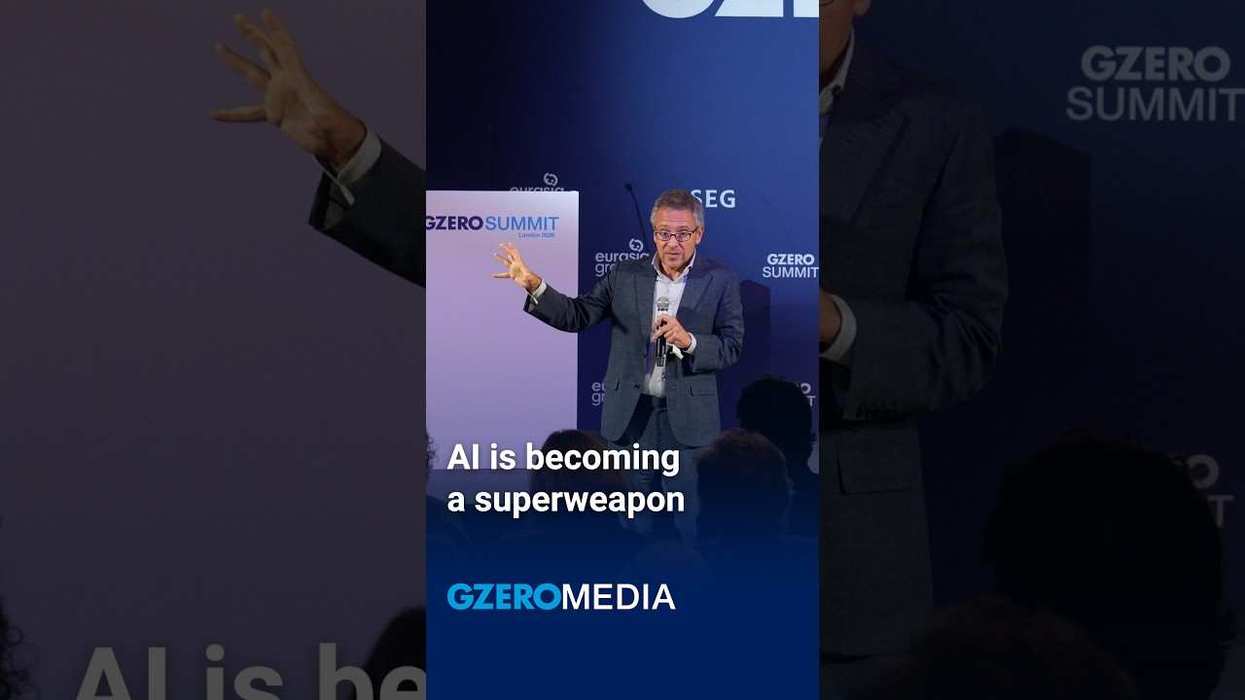
That’s the crux of the declaration: Artificial intelligence isn’t just something to be controlled, but a technology that can — if harnessed in a way that respects human rights and privacy — help society solve its biggest problems. During a recent panel conversation led by Eurasia Group and GZERO Media founder and president Ian Bremmer (also a member of the HLAB-AI group), Google’s Manyika cited International Telecommunication Union research that found most of the UN’s Sustainable Development Goals could be achieved with help from AI.

While other AI treaties, agreements, and declarations — such as the UK’s Bletchley Declaration signed last year — include a combination of governments, tech companies, and academics, the Manhattan Declaration focuses on those actually researching artificial intelligence. “As AI scientists and technology-policy researchers, we advocate for a truly inclusive,

global approach to understanding AI’s capabilities, opportunities, and risks,” the letter concludes. “This is essential for shaping effective global governance of AI technologies. Together, we can ensure that the development of advanced AI systems benefits all of humanity.”

More For You

Immigration and Customs Enforcement (ICE) agents check the identity documents of a group of agricultural workers at a grocery store parking lot during an immigration raid in Mecca, California, U.S. December 19, 2025.

Immigration and Customs Enforcement (ICE) agents check the identity documents of a group of agricultural workers at a grocery store parking lot during an immigration raid in Mecca, California, U.S. December 19, 2025.

REUTERS/Daniel Cole
A year into US President Donald Trump’s second term, America’s immigration policy has undergone one of its most sweeping resets in decades. Unauthorized border crossings are at 50 year-lows. While the administration says its focus is the “worst of the worst” criminals, immigration enforcement has expanded to include all undocumented immigrants, [...]
​President Donald Trump delivers an address to the nation from the Diplomatic Reception Room of the White House, in Washington, D.C., U.S. Wednesday, Dec. 17, 2025.

President Donald Trump delivers an address to the nation from the Diplomatic Reception Room of the White House, in Washington, D.C., U.S. Wednesday, Dec. 17, 2025.

Doug Mills/Pool via REUTERS
Less than one day after US President Donald Trump declared a military blockade of sanctioned oil tankers from Venezuela, he addressed the nation during a rare primetime speech – but didn’t talk about Venezuela. Instead, he touted the economy, arguing that it’s doing better than many Americans believe it is.“Boy, are we making progress,” Trump said [...]
French President Emmanuel Macron, German Chancellor Friedrich Merz, Ukrainian President Volodymyr Zelenskiy, U.S. Special Envoy Steve Witkoff and businessman Jared Kushner, along with NATO Secretary-General Mark Rutte and otherEuropean leaders, pose for a group photo at the Chancellery in Berlin, Germany, December 15, 2025.

French President Emmanuel Macron, German Chancellor Friedrich Merz, Ukrainian President Volodymyr Zelenskiy, U.S. Special Envoy Steve Witkoff and businessman Jared Kushner, along with NATO Secretary-General Mark Rutte and otherEuropean leaders, pose for a group photo at the Chancellery in Berlin, Germany, December 15, 2025.

Kay Nietfeld/Pool via REUTERS
The European Union just pulled off something that, a year ago, seemed politically impossible: it froze $247 billion in Russian central bank assets indefinitely, stripping the Kremlin of one of its most reliable pressure points. No more six-month renewal cycles. No more Hungarian vetoes. The money stays locked up, full stop.Turns out that was the [...]
​US President Donald Trump, Ukrainian President Volodymyr Zelensky, German Chancellor Friedrich Merz, French President Emmanuel Macron, UK Prime Minister Keir Starmer, Italian Prime Minister Giorgia Meloni, Finland's President Alexander Stubb, NATO Secretary General Mark Rutte and European Commission President Ursula von der Leyen at the White House in Washington, D.C., USA, on August 18, 2025.

US President Donald Trump, Ukrainian President Volodymyr Zelensky, German Chancellor Friedrich Merz, French President Emmanuel Macron, UK Prime Minister Keir Starmer, Italian Prime Minister Giorgia Meloni, Finland's President Alexander Stubb, NATO Secretary General Mark Rutte and European Commission President Ursula von der Leyen pose for a family photo amid negotiations to end the Russian war in Ukraine, at the White House in Washington, D.C., USA, on August 18, 2025.

REUTERS/Alexander Drago
– By Lindsay NewmanAs his second term came into view, US President Donald Trump put the world on notice that the administration many had been preparing for may not be the one it would be getting. Promising a “golden age of America,” Trump laid out an ambitious agenda. “America First” would no longer be an isolationist story, but an aspirational [...]