– By Alex Kliment
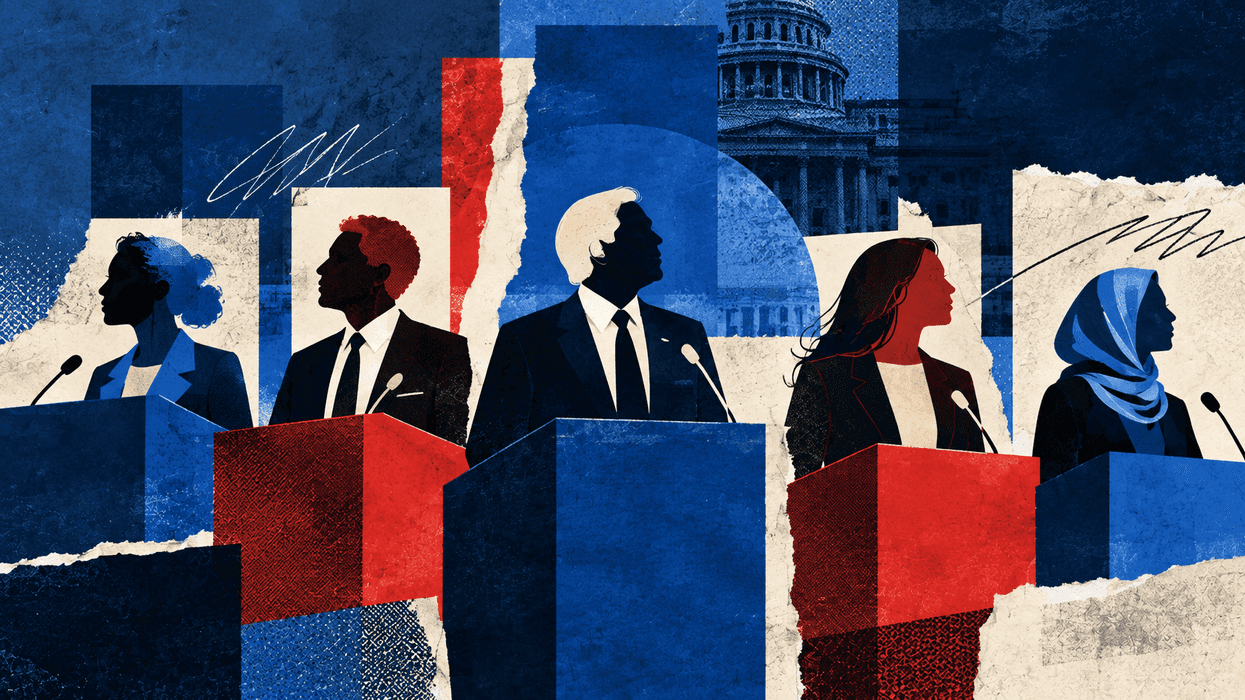
It’s become commonplace in recent years to say that America is deeply polarized. That we are a country of people split into increasingly irreconcilable extremes of belief, ideology, and politics. That we are tearing ourselves apart.
But at least one prominent scholar of American politics has a slightly different view of this. Morris Fiorina is a political scientist at Stanford University, and a Senior Fellow at the Hoover Institution. He has written for years about American politics, focusing on public opinion, elections, and political representation.
At a moment when America feels more divided and on edge than at any point in decades, I called up Dr. Fiorina to ask him what he thought. Our conversation has been edited for clarity and concision.
AK: Dr. Fiorina, in your work you have argued against the idea that Americans are hopelessly polarized – why?
Fiorina: Well, if we are more polarized, then you’d expect ordinary people today would be much more likely to say they're liberals or conservatives – and much less likely to say they’re moderates – than 50 years ago.
In fact, that/s not the case. “Moderate” has always been the preferred position, it’s still about 40% of the population, then as now. So there’s no evidence that the middle is actually giving way to the extremes.
What’s actually happened is that the political parties themselves have become more homogeneous and polarized in their positions. For example, when Jimmy Carter ran for president in 1976, only a quarter of Democrats said they were liberals. Today, it’s two- thirds. When Jerry Ford was the GOP candidate that year, 50% of Republicans said they were conservatives. Today, it’s three-quarters.
Today, everybody in each party has gone to the liberal or conservative position. So the days when you could have cross-party coalitions where liberal Republicans got together with conservative Democrats are gone. Those people are almost non-existent now.
AK: When you say “Republicans” and “Democrats,” do you mean elected officials? Registered voters? Activists?
Fiorina: Great question. There’s a big difference between normal people and the political class. The political class are the roughly 15% of the country who live and breathe politics. These are the people who give money, who work in campaigns, who post on Facebook and go on BlueSky and X and so forth. These are the people you basically avoid at cocktail parties.
And so when we’re talking about polarization, that’s primarily where it is now. Among the political class. It’s percolated down, simply because of party sorting. The average Democrat now has more differences with the average Republican than they did 50 years ago. But there too, when you ask people if they “like” Republicans or Democrats, they’re generally not thinking about their neighbor who has a Harris or a Trump bumper sticker. They’re thinking about the people they see on TV. The political class. If you really make it clear that you’re talking about ordinary Democrats and Republicans, the polarization is not nearly as strong.
AK: What accounts for this ideological sorting of the two parties?
Fiorina: One reason is demographic change. After the 1960s, the Southern Democrats and the Sun Belt basically became Republican and the Great Migration of African Americans northward shifted urban politics.
But a lot of it was also unpredictable. In 1960, I’d have guessed the Democrats would become the pro-life party—after all, they had the Catholics and the Southern Baptists. And I’d have guessed Republicans would be more focused on the environment—they were the party of Teddy Roosevelt, the National Parks system, and so on. But things didn’t go that way.
There’s also the nationalization of politics. It used to be that every big city had multiple papers and most small towns had papers too. That’s largely gone now. People don’t know as much about their local candidates. It’s mostly national coverage of national issues now.
And there’s the financing. When I was just starting out as an assistant professor, the average House campaign was much cheaper than today, yes, but also most of the money came from local people, friends, neighbors, and local interest groups.
Now it’s mostly national fundraising networks. GOP money from Texas goes into Republican races everywhere, Democratic money from Hollywood and Manhattan goes into Democratic races everywhere. All of that imposes a much more homogenous and divided national agenda on candidates and parties.
AK: I’m struck that you didn’t mention social media as a factor.
Fiorina: This all started well in advance of social media. This was going on for 30 years before Facebook. So there is a lot of exaggeration about social media, but studies show how few people actually pay any attention to politics on social media. Less than 1% of registered voters visit BlueSky daily, for example. But again, these are the visible people. These are the political class people we think of when we think of national politics. So social media is blamed for things by people who don’t have a sense of history, and they’re also probably people who are on social media a lot.
AK: We’re talking just a few days after the assassination of Charlie Kirk, which was the latest in a string of high profile acts of political violence affecting prominent figures of both parties. How does that trend fit in with your thinking about polarization?
Fiorina: Well, we have always been a violent society. We had 70 years of labor wars [in the late 19th and early 20th century] when hundreds of strikers were shot down by the National Guard, and even army troops. And in the sixties, violence of this kind was typical. Between my senior year of high school and my senior year of college, John F. Kennedy, Robert Kennedy, Martin Luther King, and Malcolm X were all shot. One of the things that I think scares people today is they don’t remember these episodes which were much worse.
AK: If the problem is party polarization rather than popular polarization, what’s the cure?
Fiorina: I’ve been asked that question for 20 years and I don’t know. What worries me most is simply that we have this political gridlock and stalemate at a time when we face genuine problems – budgetary problems, ecological problems, international problems. And right now, our political system is simply incapable of coming together and doing something positive.