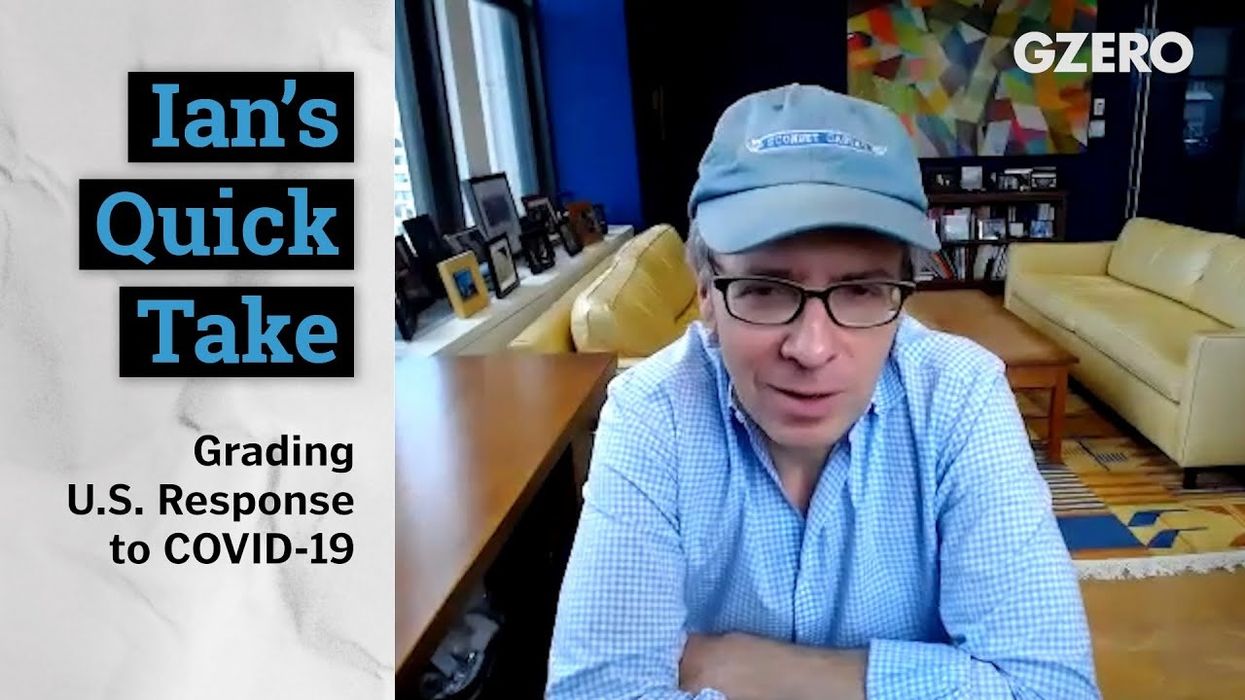
Ian Bremmer: US response to COVID-19 is mediocre
May 15, 2020
Global Stage LIVE from United Nations WATCH REPLAY
Ian Bremmer, political scientist and president of Eurasia Group and GZERO Media, shares insights on global political events.
Presented by

I continue to see incredible polarization: the United States is a hot mess, a disaster, vs no, best response ever, depending on what side of the political agenda you're on. I think that the US response so far, continues to be mediocre.
The big story: people dying. Trump should not have been a cheerleader. He said less than 100,000 would be great. Now, even the most conservative model the US government is using is now expecting 147,000 deaths by August. Well over 150,000 by election day. Trump will say, if I had done nothing, we would have 2.2 million deaths, framing for advertising. But it's hard to sell that.
On the messaging front, the US is a hot mess. On Twitter, the American president is more divisive than anyone in developed world, though less so than Bolsonaro in Brazil. But actual per capita deaths in the United States compared to all of Europe - slightly better than average. Worse than Germany, which is best of the large economies. But considerably better than Spain, Italy and France. We should be looking at per capita death, not overall. Given the size of your population, how many people are suffering? Especially as you're thinking about opening the economy and how quickly. Spain opening earlier, their numbers are going up. That shows what we can expect in parts of the US with similar caseload. If you look just at New York, we look a lot worse. If you look only at cities that are the worst hit, they look a lot worse than the United States.
I wish we could have Merkel type response; I'm glad we don't have Macron or Boris Johnson response. What's in between? On the economic front, the United States so far has been strong. Why? We have a federal government that functions. The Europeans don't. As a consequence, you've got talk about lawsuits between the German High Court and Europeans. Von der Leyen from the European Union saying this won't stand. The fiscal environment is incredibly contentious in Europe. So far early days, US bipartisan support for the economy has been strong. Same from the Fed. That's one of the reasons the American markets are performing well, right now.
Concern that I have with an election coming up in November is that we're not going to be able to sustain that. Most Senators that I talk to are worried about that, even though the Senate is pretty moderate and there's good connections between Republicans and Democrats. Not everyone is like Rand Paul, disruptive, irresponsible. But they're worried that we're not going to be able to get the trillions necessary to keep the unemployed and underemployed afloat. To keep businesses from going bankrupt. And to keep large companies that don't have a profitability model, like in hospitality, entertainment, airlines, other companies that get hit the worst on the back of this crisis. This is going to get a lot more problematic and the US economic response, which earns an A-minus so far, probably looking like a B, a C or even a D, as we get closer. Bill Gates famously gave Trump a D-minus for his response. I think Bill is focusing mostly on the lack of health care coordination side early, plus the communications.
Short of a vaccine, almost everything on treatments so far doesn't look like it changes how quickly we can reopen economies. It's more about how comfortable you feel about caseload and tracing. And contact tracing, even though we do have apps that are coming online - wonderful to see Google and Apple working together, but if you're going to need 60-70% minimum compliance for populations for that to work effectively - Facebook has 70% penetration. There is no way you get that voluntarily from Americans, major European populations. Even in Singapore, which is a tiny population, very wealthy, and doesn't care as much about democracy, only had 15-20% compliance with their contact tracing app.
Contact tracing works, but you need to have data in one place and share it. People doing the work, making phone calls, contact tracers, millions of people across the developed world. We are nowhere close.
A vaccine needs to not only be developed but proven and manufactured at scale, distributed with education. That process, start to finish, is three years. That's why I continue to think that the economic implications of this are going to be much worse than we've seen.

Keep up with what’s going on around the world - and why it matters.