Ukraine’s killer dune buggies
January 11, 2023
Global Stage LIVE from United Nations WATCH REPLAY
Read the latest news from GZERO with insights on global events.
Presented by
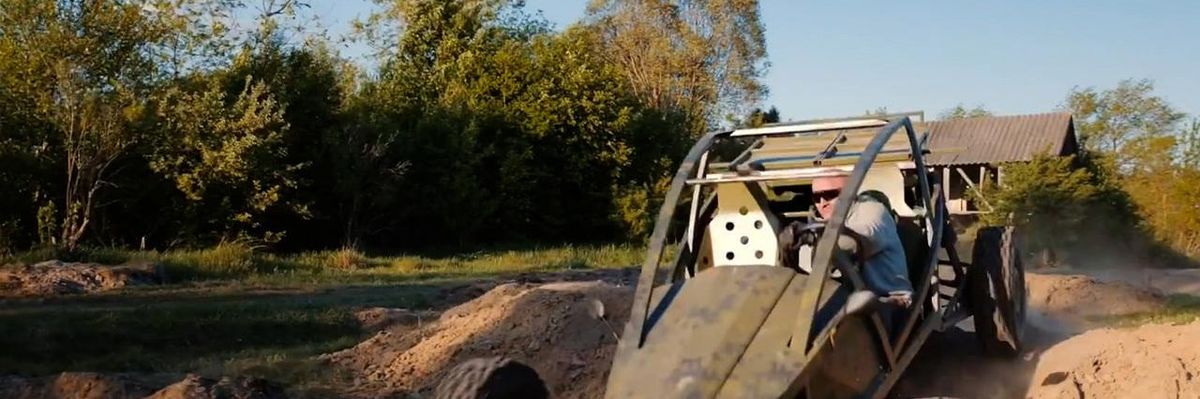
“Pah! pah! pah! pah!” Volodymyr Sadyk, a metalworker from western Ukraine, clambers into the seat of a battle-ready dune buggy in the yard of his shop near the Romanian border, imitating the sound of a heavy gun blasting away at Russian positions.
Sadyk is the founder of VOLS, a company that makes these custom buggies for the Ukrainian army.
Before the war, his speciality was metal gates, but in his spare time, Sadyk and his pals built and raced their own buggies – bare-bones, open-topped vehicles with big, rugged wheels, and screaming rear-mounted engines.
When Russia invaded last February, Sadyk had an idea — he offered some of them to the Ukrainian army. The feedback was immediate: send more.
Since the earliest days of the war, Ukrainians have come up with DIY ways like this to even the playing field against a much larger enemy. There was, for example, a moment early on when Ukraine’s tractors were briefly a social media sensation for taking on Russian tanks.
“War always produces innovation,” says Gian Gentile, a retired US Army colonel and military historian at the RAND Corporation. “But on top of that, the Ukrainians are fighting for their survival. It’s an existential fight for them, and this kind of inventiveness is the result of that.”
Plated with thin, lightweight armor — good for stopping a rifle bullet but not much more — the VOLS buggies can carry as many as 8 men, reach speeds of 60 miles per hour, and can be outfitted with heavy guns or anti-tank weapons.
The Mad Max-style vehicles are perfect for Ukraine’s wide open battlefields, which often get too muddy for other support vehicles, especially in the winter. The Ukrainians use them for various missions: to sniff out Russian positions, swarm Russian tank columns, or evacuate wounded troops.
“When our tanks go in on an offensive, the buggies come in from the sides,” Sadyk explains, tracing with his hands an imaginary swarm of buggies darting over the undulating terrain. “They come through the ravines and valleys, providing cover and totally knocking out the enemy.”
These aren’t the first buggies to see combat. Ever since California surfer Bruce Meyers built the first ones in the 1960s – using the chassis of the Volkswagen Beetle which givesthe buggies their name – the rugged, agile vehicles have attracted military attention too. The US Army has long used buggy-style “attack vehicles” of its own, deploying them in Kuwait, Iraq, and Afghanistan.
How much have they changed the war? They haven’t boosted Ukraine’s combat ability the way that, say, the US-built HIMARS advanced rocket systems have, experts say.
But for a much smaller army seeking whatever advantages it can, every little bit counts, according to Liam Collins, a retired US Special Forces officer who has advised the Ukrainian Ministry of Defense.
“Nothing is going to be a game changer,” he says, “but every little piece of the puzzle matters. The Ukrainians don’t have the mass that they need, but what they get with these is speed and surprise.”
To date, Sadyk’s company has built almost 60 buggies for the army, and VOLS claims they’ve been used in more than 10,000 combat missions. He and his crew of seven men rely on crowdfunding to source parts and materials from across Europe, and to help pay their own small salaries.
Sadyk says that only a handful of his buggies have been destroyed, but repairing them is part of the job. One buggy recently rolled over and lost a wheel while evacuating wounded troops. “The guys were fine, just some bumps and bruises,” Sadyk says. “They sent us the buggy, we fixed it all up and sent it right back out to them.”
Sadyk sells the buggies for $6,000 to $10,000 apiece, depending on how they are kitted out. How much profit is that for him? He pinches his fingers together tightly. Not much.
“We just make the minimum that’s necessary,” he says, “so we can be ready to produce as many as possible – to meet the need, because the need for them is so great.”
Regular Ukrainian citizens are turning dune buggies into war machines: here is the story of Volodymyr Sadyk.










































































Keep up with what’s going on around the world - and why it matters.