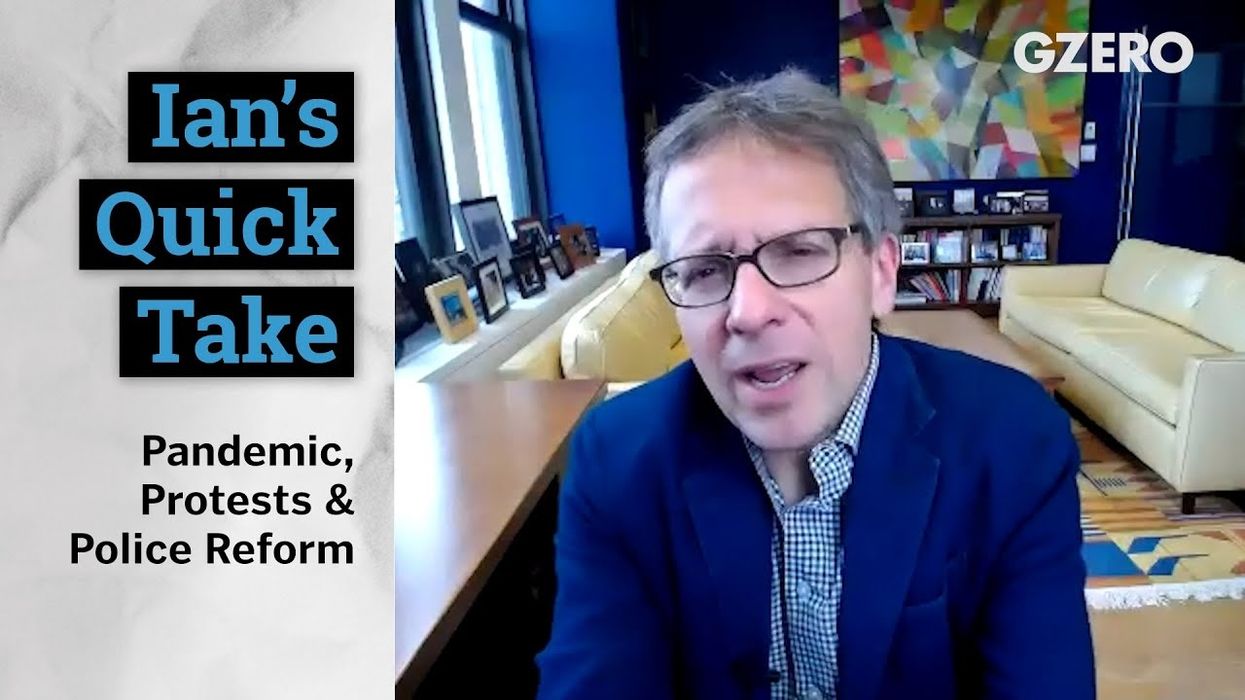
Quick Take: Pandemic, protests and police reform
June 15, 2020
Global Stage LIVE from United Nations WATCH REPLAY
Ian Bremmer, political scientist and president of Eurasia Group and GZERO Media, shares insights on global political events.
Presented by

Ian Bremmer's Quick Take:
Yet another Monday of pandemic, of social discord, of economic contraction. It's just kind of what we're expecting this summer in 2020, elections coming up. I've got a Quick Take for you. Look at a few of the things that seem interesting to me right now.
I mean, first of all, I haven't talked as much about my response to Black Lives Matter and these massive protests around the country. Obviously, I'm very sympathetic to the cause. There's massive inequality and massive racism in the United States. And this community has faced the worst of all possible worlds, not only from policing, but also from the unemployment and the health care challenges that have come from coronavirus. It's like the perfect storm this summer.
And so, you can easily understand why that video so hard to watch of George Floyd, almost nine minutes, as he's killed by these police officers, would lead to such extraordinary outburst, such deep anger and pain across the country. I will tell you that I am not a fan of the term "defund the police." And frankly, I think it's fortunate for Joe Biden that he decided not to take that on. I've heard from folks in the White House that they were hoping that he would really grab that slogan because they think it's problematic for those that support it. It sounds great, but I don't think taking money away from the police would actually solve the problem. It would probably make police officers feel more insecure and have them be even worse trained.
One of the biggest problems in the United States is that training for American police is radically inadequate. They get so much less training than police in Canada, across all the major European countries, I mean, even emerging markets, democracies like India, where the training isn't very good, but it's a lot longer. The United States just has really defunded training for police. And so, as a consequence, you have a lot of people on the force that don't have a good sense of what experienced community policing needs to be like. And remember, a couple of the police officers that were there, of the four, that killed George Floyd, had been there for four days. I mean, you know, it's a real problem when you have inadequate training. And defunding the police is not going to lead to better training, it will probably lead to less.
You also have militarization of police, an enormous amount of advanced, whether it's riot armor, grenade launchers, armored plated vehicles. I mean, when you looked at what Ferguson ended up having in Missouri and why you think the police were not seen as part of the community, a big part of it is not enough training and massively gunned up. And that's a problem for all communities, black community, white community, Hispanic community. But, of course, when the most troubled areas are the poorest, you're going to end up with the worst policing and the biggest disparities in those areas. And again, the African American community in the United States getting the worst of it. So, for me, it would not be "defund the police," it would be "fund the police differently." It is not a pretty exciting, catchy phrase to get people on the streets, but it is probably what's necessary. I don't think we need as many police. I think we need them to be vastly more skilled and trained and with less militarization. We could learn a lot of lessons from what they do in places like Canada and Germany and Holland, the Netherlands, less so what we're doing here in the United States.
Another question, what are we doing about coronavirus? I mean, we have so many people out there demonstrating, protesting. We're now going to have rallies starting again this week with President Trump. These are large numbers of people gathering together. We had been hearing for months that you shouldn't be gathering together, you should be socially distancing. Very hard to socially distance when you're at a rally or when you're at a mass protest. And especially when people aren't wearing masks or when those that are don't know how to wear them or put them on and take them off properly, you're going to get more spread. It's good that it's largely outdoors. That clearly will limit the level of spread.
We are also seeing that a lot of states opened up early and opened up maximally as opposed to gradually in Europe. In Europe, the curve is being bent down. In a lot of American states, you're seeing explosive growth in cases on the back of those openings, particularly in southern states and some of the southwest. Even starting to see a number of hospitals get dangerously close to being overwhelmed from ICU patients that have coronavirus. This is dangerous stuff.
The ability to tell protesters stop protesting in this environment is nearly zero. The ability to tell Trump you shouldn't have rallies when you haven't said anything about problems with all of the mass protests for Black Lives Matter, is virtually nil. And the ability to tell people that have been in place in lockdown for months and have lost their jobs or losing their jobs and don't know how they're paying the next bill, you can't go back to work as they're opening up, try to stop that opening or slow down, almost impossible. So, we're probably heading to a much more significant second wave than we would have had otherwise.
I will tell you, if it were up to me, what I'd like to see in the United States, is universal mask wearing. Mandatory, with significant fines. I mean, I'm seeing in some cases in the Gulf, thousands of dollars if you're not seen wearing a mask properly in a public space. That's what I think we need in the United States. That at the same time as you open up the economies. You'd still end up with more spread than you'd like, but you would have far less than we're looking at right now. And the economy would pick up more quickly. People are going to say, "I don't want to wear a mask," you know, "how dare you say that? It's against my American rights. Individualist." You know, in Orange County, we have all these people complaining, saying, "I don't need to wear a mask." Well, you know what I mean, for me, in a pandemic, I am willing to suspend your ability, your individual rights to get infected and to pass that infection on other people, because I want to improve the economy and I don't want as many people dying from coronavirus. That would be my choice. I suspect that's going to be controversial.
It's inconceivable that we're going to implement it because we have a president that refuses to wear a mask himself and thinks it's a sign of virility and masculinity for others not to. And so there's a lot of a refusal to make that announcement. You also have all sorts of people out there that are demonstrating for rights that are way overdue and very angry about it, understandably so. And they're not going to listen if you tell them to wear a mask, irrespective. And it's almost impossible to police that, especially when the police department is seen as delegitimized. And then you have a lot of Americans just don't listen to authority no matter what. You know, it's a "we know better." I mean, you can't get people to wear motorcycle helmets. How do you get them to wear masks? But still, that's what I would do. But, you know, I'm not running the country. So, it's not up to me.

Keep up with what’s going on around the world - and why it matters.